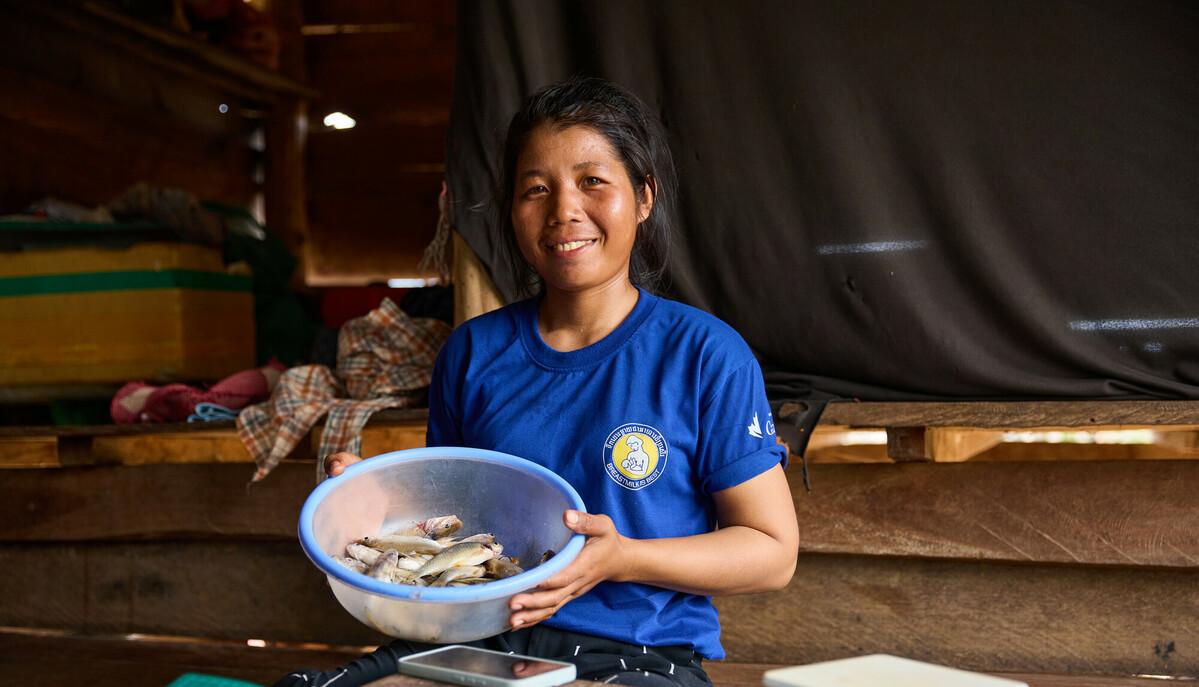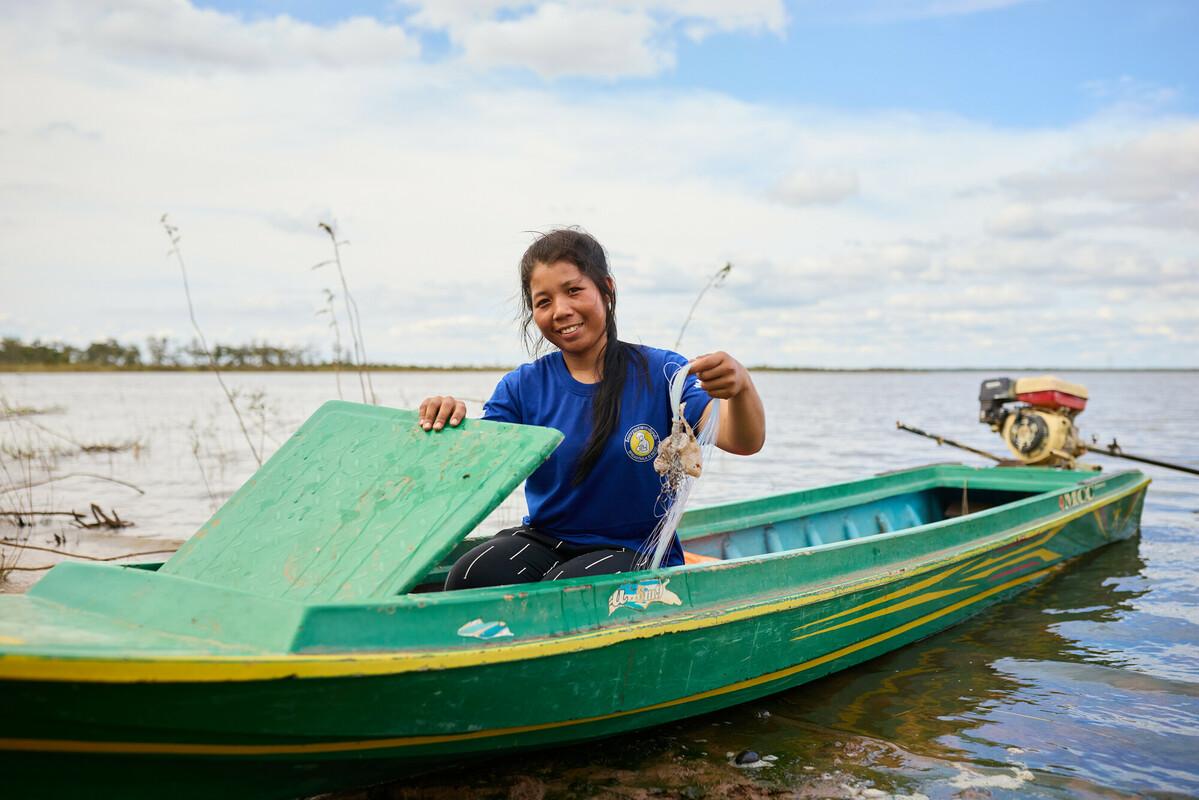
Cambodia: Chhorvy is a community leader who developed her skills in fish catch monitoring through local partner MVi (My Village). She also conducts eco-training sessions for fellow fisherfolk, sharing her knowledge with the community. Photo: Patrick Moran/Oxfam
Cambodia
Oxfam supports communities in Cambodia to overcome poverty and inequality.
Cambodia’s rivers are its backbone. The Tonle Sap and Mekong support fishing and farming for millions of people. But rapid development is disrupting long-held balance. Changing water levels, fish migration and the ecosystems that families rely on for food and income.
Climate change adds more pressure. Rainfall is becoming less predictable. Droughts and flash floods more frequent.
Through all of this, Cambodian communities are leading sustainable change. When you make a donation to countries like Cambodia through Oxfam, you’re backing that leadership.
Your support can assist women’s participation in local decisions, strengthen local voices in water and energy planning, and help families adapt as river systems and seasons shift. Support development that is fair, inclusive and grounded in local knowledge.
Why your support matters in Cambodia
Cambodia’s food systems and local economies depend on its rivers. The Tonle Sap Lake and Mekong River shape planting seasons, fishing patterns and access to water. When river flows shift (even slightly) families feel it in their food supply and income.
These systems are under increasing pressure. Hydropower development can change water levels and fish migration. And UNDP reports more erratic rainfall, hotter temperatures and growing risks of drought and flash flooding. For farming and fishing communities, unpredictable seasons make it harder to plan operations, harvest crops to eat and sell, and earn a reliable income.
Structural inequalities make this even harder. Women shoulder significant unpaid labour and often have less influence over village or district decisions. Rural and river-dependent communities also have limited say in development projects that affect their land and water.
Yet Cambodian communities continue to lead. Women’s groups and local networks share information, track environmental changes and powerfully advocate for fairer development outcomes. When you make a Cambodia donation through Oxfam, you help strengthen this community-led leadership — backing local knowledge, protecting rights and supporting families adapting to shifting rivers and climates.
How Oxfam is working in Cambodia
Supporting inclusive decision-making about water
Our aim for The Inclusion Project is simple: the people most affected by changes to river systems should have a real voice in shaping those changes. Oxfam works with local organisations so communities can take part in decisions about their water, land and forests. The Inclusion Project focuses on making sure people who rely on the Mekong and Tonle Sap (especially women) are included when development plans are discussed and approved.
The Mekong Inclusion Project is supported by the Australian Government and the Swiss Agency for Development and Cooperation (SDC).
Strengthening women’s leadership and rights
Across Cambodia, Oxfam supports women to participate in village planning and local development. Partners help improve access to information and create leadership opportunities so women can influence decisions that affect their livelihoods and futures.
Influencing a just and people-centred energy transition
Cambodia is part of a regional shift toward more sustainable and affordable energy. Through the ANCP-supported I-JET program, Oxfam helps civil society engage in ASEAN energy discussions and share analysis with policymakers, investors and multilateral banks. The aim is a transition that protects communities and increases access to affordable, renewable energy.
Working alongside local organisations
Every aspect of Oxfam’s work in Cambodia is done through local partnerships. Community organisations and civil society networks lead the work, drawing on deep local knowledge and lived experience. Oxfam’s role is to strengthen these efforts — supporting long-term, locally led advocacy for fair development, gender justice and climate resilience.
Oxfam acknowledges the support of the Australian Government through the Australian NGO Cooperation Program (ANCP).
Key focus areas

Gender Justice
Supporting women to take part in local decisions and influence development that affects their lives.

Climate Justice
Helping communities adapt to changing weather patterns and shifting river systems.

Economic Justice
Backing fair livelihood opportunities for farming and river-dependent families.

Community-led Natural Resource Governance
Ensuring people can participate in decisions about land, water and forests across the Mekong region.
Why choose Oxfam
We work alongside local Cambodian leaders and organisations who understand the challenges and the solutions. When you support Oxfam with a donation, you’re backing:
Local partnerships
Every program is grounded in community knowledge and led by local organisations.
Long-term resilience
From climate advocacy to disaster preparation, we focus on lasting impact (not just emergency relief).
Proven accountability
As a member of the Australian Council for International Development (ACFID), Oxfam follows the highest standards of transparency and effectiveness.
A regional approach
Our work in Cambodia is part of a wider strategy, ensuring solutions are shared, connected and led by the Mekong region itself.
Justice over charity
We support communities to lead their own future. It’s not about charity. It’s about fairness, dignity and equal rights.
How your donation helps
Your donation to Oxfam can support community-led work across the Mekong region and beyond. Your contribution strengthens local leadership and ensures development is more just, inclusive and grounded in lived experience. Here’s what your support can help make possible:
- Women’s leadership — supporting women to take part in village planning, community discussions and decisions that affect land, water and livelihoods.
- Climate adaptation — helping communities understand shifting weather patterns and respond to changes affecting farming, fishing and daily income.
- Participation in water and land decisions — ensuring river-dependent families and civil society groups can join discussions about development projects that affect them.
- Fairer energy transitions — backing civil society organisations with analysis and tools to engage in ASEAN energy planning and advocate for more sustainable, people-centred energy systems.
- Stronger community networks — supporting local groups working together to protect rights, share information and advocate for safer, more secure livelihoods.
Your donation is more than a moment of support. It strengthens long-term, locally led work for justice, climate resilience and community rights across Cambodia and around the world.
Learn more about Oxfam’s work in the region
Cambodia’s story is part of a wider effort across the Mekong. Want to understand the bigger picture? Explore how Oxfam works across the Asia-Pacific region to support community-led climate action and push for global systems that put justice first.
Discover Oxfam’s climate justice work. Or read about gender equality. You can explore our current appeals or learn more about the countries we work in, including Laos and Myanmar.
Donate to countries like Cambodia now
Help us work for justice and equality in Cambodia and around the world. By donating today, you’re backing the leadership of Cambodian communities who are shaping their own future.
Every contribution can help strengthen local voices in development decisions, support women’s participation in community planning, and build long-term resilience in the face of rapid environmental and economic change.
Donate now to help support climate justice and fair development in Cambodia and around the world.
Oxfam’s partners
Oxfam in Cambodia, ASEAN Centre for Energy, (XEA) Climate Action Network Southeast Asia, Oxfam Novib (ONL), 3S Rivers Protection Network (Sesan, Srepok and Sekong rivers) , Bophana Centre , Culture and Environment Preservation Association , Energy Lab , Fisheries Action Coalition Team (FACT) , Men’s Health Social Service , My Village Organization (MVi) , NGOF on Cambodia – Rivers Coalition in Cambodia (RCC) , Women Voice Community (radio) , Women with Disability Leadership and Advocacy Network