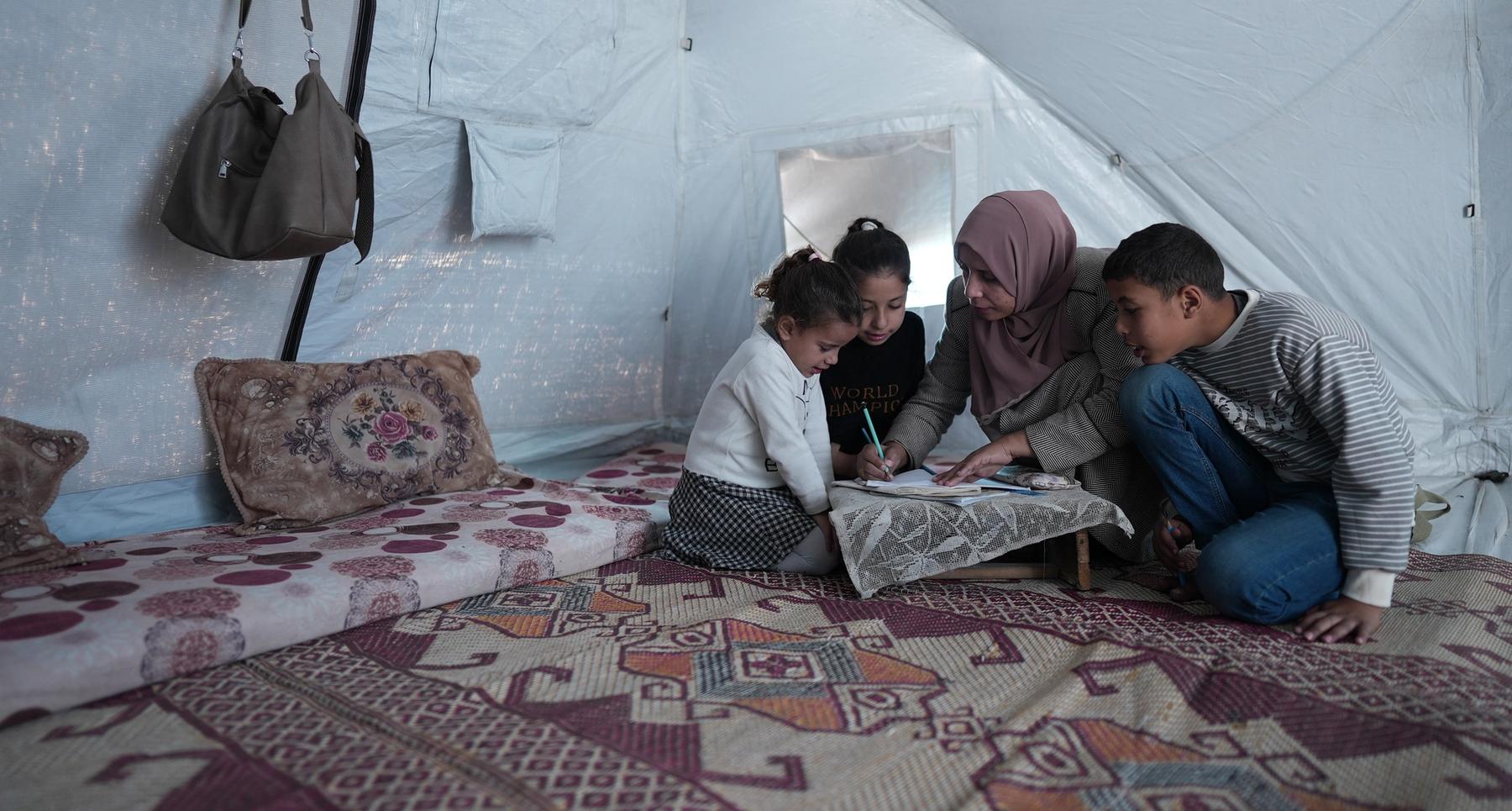
Palestinian Territory - Occupied: Hiba and her children in her tent in Al Mawasi. She is teaching them. Photo: Alef Multimedia/Oxfam
Gaza Crisis updates
Keep up to date with the ongoing crisis in Gaza, the West Bank and Lebanon.
27 Feb 2026 | Israeli High Court grants urgent request from 19 humanitarian organisations providing aid into Gaza
Reacting to the announcement of a ceasefire in Gaza, Oxfam International’s Executive Director Amitabh Behar, said:
The Israeli High Court has ruled in favour of an urgent request from 19 humanitarian organisations, including Oxfam, for an interim order which would prevent the cessation of all activities until a final ruling is reached.
In response, Oxfam’s Policy Lead, Bushra Khalidi, said:
“We are grateful that our request for an interim order has been agreed. Although this news is positive, the humanitarian situation in Gaza remains critical and we don’t yet know what effect this ruling will have.
“When the court issues its final decision on the petition submitted by Oxfam and others, we hope it recognizes the very real threat to civilian lives and upholds humanitarian principles and international law.”
25 Feb 2026 | Humanitarian organisations petition Israeli High Court as closure deadline approaches
The clock is ticking on a large part of the humanitarian response sustaining civilians in the occupied Palestinian territory.
Thirty-seven international aid organisations have been ordered by Israeli authorities to cease operations in the occupied Palestinian territory by the end of February under revised Israeli registration rules. With efforts to force closures imminent, 19 leading humanitarian organisations have taken the unprecedented step of jointly petitioning the Israeli High Court to suspend the measures before irreparable harm is done to civilians who rely on their assistance.
On 30 December 2025, the affected organisations were formally notified that their Israeli registrations would expire the following day and that they would have 60 days to wind down activities in Gaza and the West Bank, including East Jerusalem. The notification letter stated that the decision could only be overturned if organisations completed the full registration process, with which they cannot legally or ethically comply.
Efforts to force closures could begin as early as 28 February 2026. The effect would be immediate, extending well beyond individual organisations to the wider humanitarian system. In Gaza, families remain dependent on external assistance amid continuing restrictions on aid entry and renewed strikes in densely populated areas. In the West Bank, including East Jerusalem, military incursions, demolitions, displacement, settlement expansion and settler violence are driving rising humanitarian needs.
14 Jan 2026 | 100 days into ceasefire Gaza still deliberately deprived of water as aid groups forced to scavenge under illegal blockade
Oxfam and partners restore limited water access for 156,000 amid near-total water and sanitation infrastructure collapse.
100 days into the ceasefire announcement, in a week that has seen more severe weather hitting Gaza, needs remain desperate. Oxfam and dozens of other INGOs working in Gaza have had to further adapt their operations to keep life-saving work continuing, even as they face uncertainty over new registration requirements imposed by Israeli authorities.
Despite months of severely restricted aid inflows, amidst power disruptions, access shutdowns and repeated rejection of essential materials, work has continued. Oxfam has worked around the clock with experts from local partner organisations, to restore vital water wells – even sifting through rubble to salvage and repurpose damaged materials, including sheet metal.
According to assessments carried out by Oxfam’s partner, the Coastal Municipalities Water Utility (CMWU), the total cost to rebuild all of the water and sanitation facilities, systems and infrastructure which have been destroyed or damaged by Israel in Gaza will be around $800 million. However, the figure could be even higher, since parts of Gaza remain inaccessible and construction costs have also doubled, due to the lack of materials being allowed in.
3 Jan 2026 | 53 International NGOs warn Israel’s recent registration measures will impede critical humanitarian action
International humanitarian organizations operating in the occupied Palestinian territory warn that Israel’s recent registration measures threaten to halt INGO operations at a time when civilians face acute and widespread humanitarian need, despite the ceasefire in Gaza.
On 30 December, 37 INGOs received official notification that their registrations would expire on 31 December 2025. This triggers a 60-day period after which INGOs would be required to cease operations in Gaza and the West Bank, including East Jerusalem.
INGOs are integral to the humanitarian response, working in partnership with the United Nations and Palestinian civil society organizations to deliver lifesaving assistance at scale. The United Nations, the Humanitarian Country Team, and donor governments have repeatedly affirmed that INGOs are indispensable to humanitarian and development operations and have urged Israel to reverse course.
Despite the ceasefire, humanitarian needs remain extreme. In Gaza, one in four families survives on just one meal a day. Winter storms have displaced tens of thousands, leaving 1.3 million people in urgent need of shelter. INGOs deliver more than half of all food assistance in Gaza, run or support 60 per cent of field hospitals, implement nearly three-quarters of shelter and non-food item activities, and provide all treatment for children with severe acute malnutrition. Their removal would close health facilities, halt food distributions, collapse shelter pipelines, and cut off life-saving care. In the West Bank, ongoing military raids and settler violence continue to drive displacement. Further restrictions on INGOs would sharply reduce the reach and continuity of lifesaving assistance at a critical moment.
19 Dec 2025 | Oxfam Reaction to IPC Report on Gaza showing improvement but majority still facing acute food insecurity
Responding to today’s Integrated Food Security Classification (IPC) report, Oxfam’s Marta Valdes García, Humanitarian Director, said:
“There remains appalling and preventable levels of hunger in Gaza. Israel is allowing far too little aid to enter even as it continues to actively block aid requests from dozens of well-established humanitarian agencies. Oxfam alone has $2.5m worth of aid including 4000 food parcels, sitting in warehouses just across the border. Israeli authorities refuse it all.
“With 1.6 million people found to be facing acute food insecurity, including 100,000 in Catastrophe (IPC level 5), we are incredibly concerned that winter is already bringing flooding and more misery to thousands of hungry people with little or no money, who are now exposed in terrible living conditions. Israel’s control and ongoing illegal blockade has created a humanitarian response that is restricted, unpredictable and totally inadequate to the human crisis at hand.”
10 Oct 2025 | Oxfam reaction to the announcement of a ceasefire in Gaza
Reacting to the announcement of a ceasefire in Gaza, Oxfam International’s Executive Director Amitabh Behar, said:
“The announcement of the first stage of a ceasefire deal in Gaza by all parties is a desperately needed step towards ending Israel’s genocide in Gaza. We welcome the release of Israeli hostages and unlawfully detained Palestinians.
“This fragile ceasefire must be the beginning of a sustained and principled effort that leads to ending Israel’s unlawful occupation and blockade. It must be focused on restoring rights and rebuilding lives. Any political or reconstruction plan must not entrench the occupation or further undermine Palestinian sovereignty.
“The path forward must be Palestinian-led and rooted in the fulfilment of fundamental rights. Negotiations on Gaza’s future must go beyond bricks and mortar – they must restore the foundations of daily life, rebuild shattered communities and offer pathways to healing and hope. This must go hand-in-hand with Palestinian self-determination, with Palestinians leading the rebuilding and governance of Gaza, and shaping their own future across all occupied territory.
“The ceasefire must immediately unlock full and unrestricted humanitarian access to Gaza, supported by the international community ensuring that a sustainable ceasefire is upheld.
“The international community must also ensure that Israel opens all crossings and allows aid and commercial goods to flow freely and safely at scale into every corner of the Strip. Humanitarian efforts must be UN-led and principled.
“Israel’s deliberate use of starvation, forced displacement, and destruction of civilian infrastructure over the past two years must be investigated as crimes under international law and those responsible held to account. A ceasefire marks only the beginning. It stops the killing and must pave the way for the next phase: preparing the ground for a sustainable peace and genuine reconciliation. This process cannot succeed without justice and accountability at its core, to prevent impunity and ensure the cycle of violence is not repeated.
“This moment must mark a shift towards an authentic, inclusive process grounded in human rights, equality, and dignity for all. World leaders must ensure that this ceasefire is upheld by all parties, that those who committed war crimes are investigated and prosecuted and the inalienable right of the Palestinian people to self-determination is upheld.”
22 Sept 2025 | Joint statement: Civil society responds to Australia’s recognition of Palestine
Overnight, at the United Nations General Assembly, Australia formally recognised the state of Palestine, joining the 147 UN member states that had already done so.
The international community’s support for the establishment of a sovereign Palestinian state based on justice, equality, and the will of the Palestinian people is essential. Palestinians have a right to live freely and with dignity.
While we welcome Australia’s recognition of Palestine, it is no substitute for the urgent and meaningful action that Australia must take to uphold its moral and legal obligations to prevent further atrocities against the Palestinian people, and to avoid complicity in the war crimes Israel is committing.
As Israel escalates its military offensive on Gaza City and displaces hundreds of thousands of Palestinian civilians, we reiterate our call to the Australian Government to show leadership and demand justice for the people of Palestine. Words are not enough. Australia must move beyond mere rhetoric and condemnation of Israel’s actions and take steps to uphold its international legal obligations.
10 Sept 2025 | Palestinians pushed into deeper crisis with Israeli displacement order on entire Gaza City
1 million people being forced towards unliveable, so called “humanitarian area” in mass forced displacement.
Israel’s intent to displace around 1 million civilians, half of whom are living in famine, is impossible and illegal Oxfam said today, while the Israeli military continued to flatten Gaza City building by building as its mass forced displacement of civilians in the city gains terrifying momentum.
Displacement orders, on leaflets thrown from the sky, or posted on social media, signal grave next steps, a scene all too familiar in Gaza where every order has preceded new waves of destruction and mass casualties. This is the latest chapter in the genocide that Israel is committing in Gaza and part of a broader campaign of ethnic cleansing engulfing the entire Gaza Strip, where nothing and no one has been spared.
Israel’s plan to concentrate around 1 million people into tiny slivers of already overcrowded and ill-equipped “camps” has no basis in reality, with just 42.8 square kilometres (under 12% of the Gaza Strip) allocated to this so-called “humanitarian area” for people to move to. That would mean an additional 1 million people are expected to live in under–resourced spaces located in the Southern part of the Gaza Strip, whilst most of the remaining humanitarian and emergency infrastructure is currently located in the middle area of the Strip, further limiting access to support. The plan is not only inhumane it is physically impossible and would compound disease and hunger and be a flagrant breach of international humanitarian law (IHL).
23 Aug 2025 | Oxfam reaction to IPC report confirming famine in Gaza Governorate
Reacting to the Integrated Food Security Classification (IPC) report published today, which confirms a famine in Gaza Governorate and predicts it will expand to Deir al-Balah and Khan Younis by the end of September, Oxfam’s Food Security and Livelihoods Coordinator, Mahmoud Alsaqqa, said:
“The famine in Gaza is entirely driven by Israel’s near-total blockade of food and vital aid — the horrifying consequence of Israel’s violence and its use of starvation as a weapon of war. This is what our staff and partners have been witnessing for months: people in the Gaza Strip being deliberately starved, relentlessly bombarded, and forcibly displaced — all part of Israel’s genocide.
“Mothers are now too malnourished to nurse their starving babies. People are forced to walk miles across treacherous terrain in search of food, only to be shot at militarized distribution centers. The elderly, under fire and too weak to flee, illustrate the collapse of the humanitarian system and repeated crimes against humanity."
13 Aug 2025 | Oxfam reaction to Australian Government recognising state of Palestine
Reacting to Australia’s announcement that it will recognise the state of Palestine at the 80th session of the United Nations General Assembly in September, Oxfam Australia Interim Chief Executive Officer Dr. Chrisanta Muli said:
“We welcome the announcement today that Australia will recognise the state of Palestine. This recognition is a landmark decision and is a crucial step in affirming the Palestinian people’s inalienable right to self-determination.
However, talking about recognition while a genocide is ongoing, without taking the necessary measures to stop it and ensure accountability, risks sounding tone-deaf and letting governments off the hook.
“Recognition must be part of a irreversible strategy to end Israel’s illegal occupation, dismantle illegal settlements, reunify the Palestinian territory including Gaza, the West Bank and East Jerusalem and establish full sovereignty of the State. It must also be linked to concrete, time-bound measures to lift Israel’s blockade, safeguard rights, support Palestinian governance, press for swift UN Security Council recognition of Palestine as a full member state and ensure reparation and rebuilding to address the ruinous destruction and loss inflicted on the people of Gaza.
“Gaza’s humanitarian situation is catastrophic, marked by famine spreading throughout the Strip, an alarming rise in malnutrition rates and death from malnutrition, repeated forced displacements, and the destruction of life-sustaining infrastructure and systems. Israel has deliberately blocked the entry of food, water, medicines and basic services like healthcare, with a near-total siege on Gaza, since March.
“We urgently need an immediate and permanent ceasefire. Australia must apply full diplomatic pressure to restore principled, safe, predictable, unimpeded, and sustained humanitarian access across Gaza through a return to a UN-led coordination mechanism grounded in humanitarian principles and international law.”
Donate to support
Gaza today


Stay up to date with our news, programs and appeals.