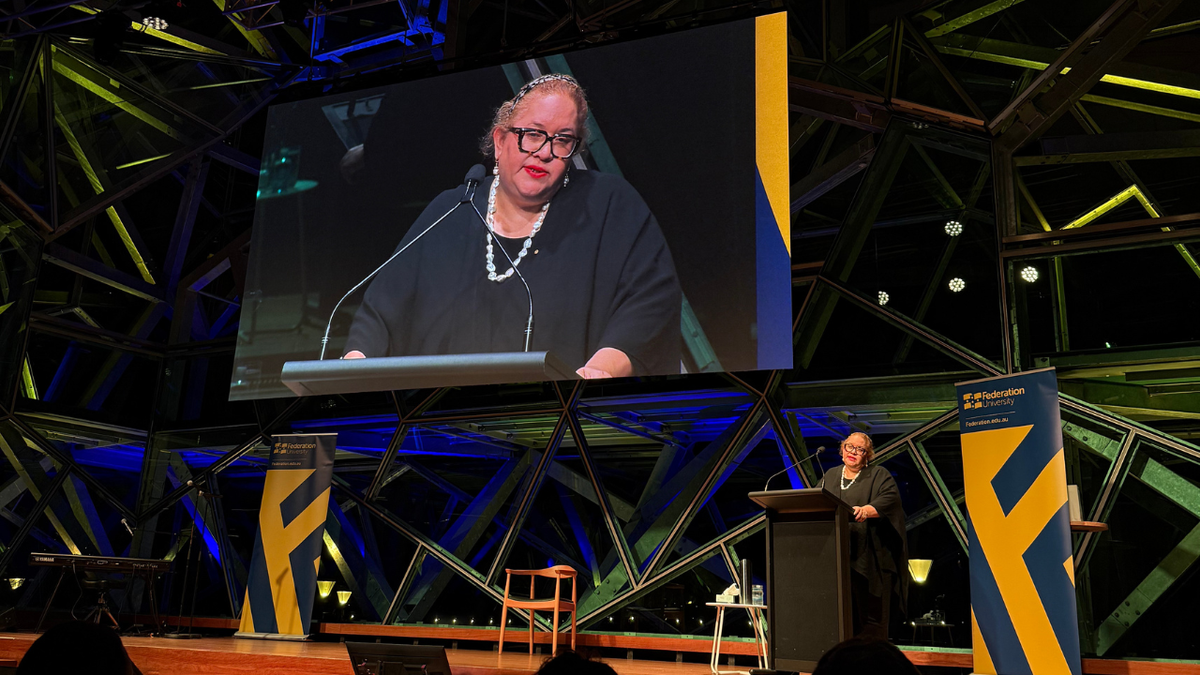
Professor Megan Davis on the Voice referendum and Australia’s unfinished constitutional debate.
In a wide-ranging address, Beyond Reconciliation: What the Referendum Revealed, hosted by Federation University’s National Centre for Reconciliation, Truth, and Justice in May, Scientia Professor Megan Davis AC reflected on the long journey towards constitutional recognition in Australia and what the Voice referendum revealed about the nation’s understanding of history, representation and belonging.
Speaking from a deeply personal starting point, Davis recalls being a United Nations Fellow in Geneva during the 1999 republic referendum, voting from abroad while feeling removed from the national debate unfolding at home. That moment marked the beginning of a much longer journey through questions of constitutional change and political inclusion, one that would span decades of legal practice, research and public advocacy.
Across years of work on constitutional recognition, Davis described a persistent tension between symbolic approaches to reconciliation and deeper questions of power, voice and participation. For her, the central issue has always been where Indigenous peoples sit within the structures of political life, not only how they are acknowledged within them.
That tension sharpened after the 2023 referendum on the Voice to Parliament. Rather than signalling the end of the debate, Davis argued it revealed how unsettled Australia’s constitutional imagination remains when it comes to Indigenous inclusion. The question, she suggested, is not only what recognition looks like, but what it means to be meaningfully included within the democratic order itself.
Living and teaching in the United States after the referendum offered Davis a different lens. She pointed to the way American political culture remains shaped by constitutional storytelling, often imperfect and contested, but consistently grounded in questions of representation and exclusion. Legal frameworks such as the Voting Rights Act reflect, in her view, an explicit recognition that formal equality alone cannot address histories of structural exclusion.
By contrast, she reflected on how rarely Australian public debate engages in these terms. Here, questions of Indigenous rights are more often framed through policy and administration than constitutional belonging, a distinction that shapes what kinds of solutions are even considered possible.
At the heart of Davis’s address was a simple but powerful idea - political loss should not be mistaken for defeat. Instead, it calls for a renewed commitment to constitutional recognition, properly understood.
The referendum result should not be read as the end of reform, but as a reminder of how much deeper the work of constitutional recognition still goes.
Davis returns us to the Uluru Statement from the Heart as an expression of that unfinished work, not a symbolic gesture but an invitation to rethink the relationship between Indigenous peoples and the Australian state. Its call is ultimately about participation, about being heard and being part of the structures that shape national life.
In that sense, the question left open after the referendum is not only what comes next, but how Australia understands who its constitution is for and who it continues to leave out. Watch Professor Megan Davis AC’s address, Beyond Reconciliation: What the Referendum Revealed.