I just got back from having a chat with some families in Takeo about some very productive cow banks that Oxfam helped set up.
Cow banks are like “store” of cows people can borrow to help them work their fields or use for breeding. The (simplified) steps for creating a cow bank are:
- A rural community sets up a cow bank committee and selects families that most need a cow. Oxfam facilitates the process.
- Oxfam buys a bunch of cows, which are given to the cow bank.
- The cows are lent out to families for work or breeding until the female cows have offspring. Once calves are old enough to reproduce, the original cow is passed onto another family in need.
The trip was partly a follow-up to story-gathering training we’ve been doing, with my workmate Kung taking some amazing photos and doing excellent interviews. I was stoked that my slowly improving Khmer meant I could follow a decent chunk of the interview without translation.
Multi-purpose cows
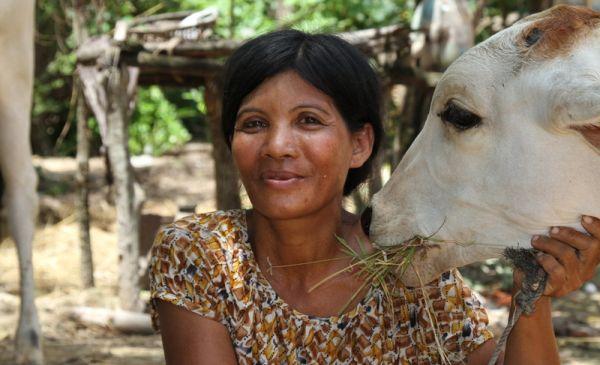
The men and women we interviewed talked a lot about manure (yes, we talked a lot of s….). In Takeo, female cows aren’t used for plowing, but their manure is sold as A-grade fertiliser and used on home-grown vegies. The cows are regular, so the income is too. Aside from manure, the cows are a valuable asset for rural families, as Long Sokha explains:
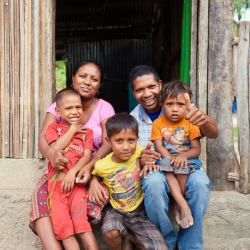
“Before the cow I could not get a loan. After I got the cow I used it as collateral and I got a loan. With the loan I bought a sewing machine (non-electric) and now make clothes to sell.”
With her increasing income Sokha is now able to send two of her six children to school.
Cows, chickens or pigs?
Aside from collateral, manure isn’t the highest-value product around, so I had to ask Kung about why we provide cows? Chickens or pigs seem to generate income a lot quicker.
“Chickens and pigs produce income quicker, but many families we work with face long food shortages,” says Kung.
“If we provide pigs or chickens, they are often eaten during a food shortage which means no long-term benefit. Cows won’t be eaten because they are more valuable and durable, while cow bank members can easily check up on the cows. As the cows reproduce, families have an exponentially growing income.”
Equipped with a cow, Sokha’s family are paving their own way towards a better future, while I now understand another effective adaptation of “teaching a person to fish…”