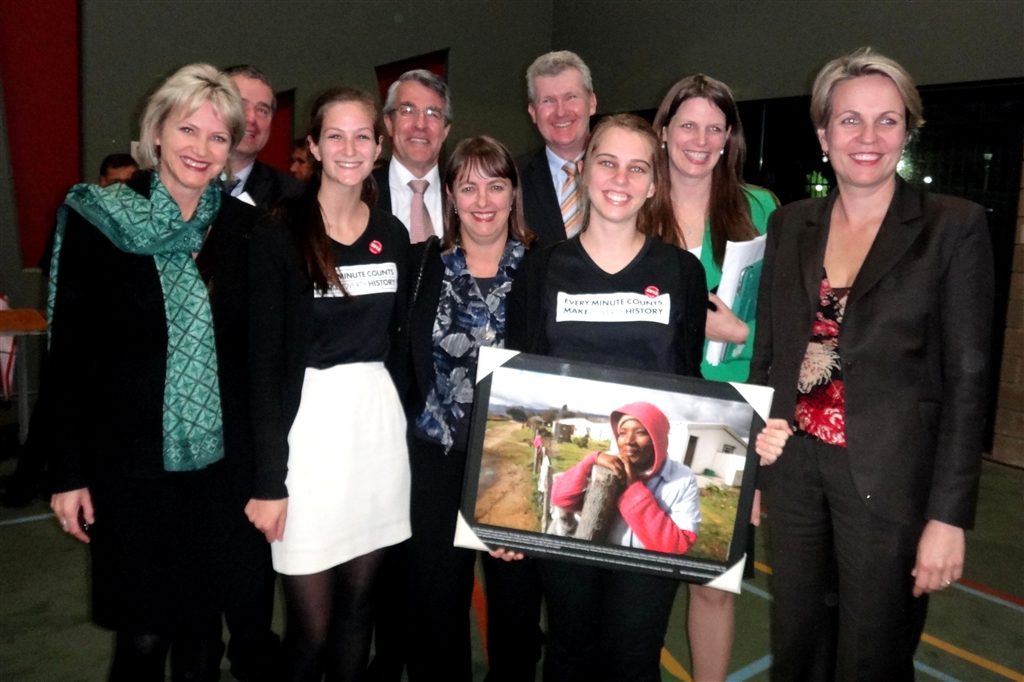
Last night, prior to the Perth Community Cabinet, four Government Ministers, the Attorney General and a Parliamentary Secretary joined forces with local Fremantle MP to support the Make Poverty History campaign.
Fremantle MP, Melissa Parke, together with Attorney General, Nicola Roxon; Minister for Employment, Kate Ellis; Minister for Health, Tanya Plibersek; Minister for Broadband, and Deputy Leader of the Government in the Senate Stephen Conroy; Minister for Environment, Tony Burke, and Parliamentary Secretary for Climate Change, Mark Dreyfus stood in solidarity with Make Poverty History supporters Kathryn Richards and Nanwen Sounness to show their support for the campaign. Kathryn Richards and Nanwen Sounness are the President and Vice President of the Oxfam UWA group and have recently raise $8 000 this year for the West Africa Food Crisis Appeal.
During the Community Cabinet Prime Minister Julia Gillard also got into action on the issue, choosing the Make Poverty History representative to ask the first question of the night.
Make Poverty History spokesperson Paddy Cullen congratulated the PM on her new role as a co-chair on a high level United Nations team of world leaders tasked with implementing the Millennium Development Goals, and asked how she intended to go about this task. He also asked if there would be implications for Australia with this new role and if we would now be seeking to achieve the United Nations recommended target of 0.7 per cent of gross national income (GNI).
The PM spoke about the importance of aid in ridding the world of preventable diseases and allowing children to gain an education. She said she had a big responsibility and would be encouraging world leaders to work hard to achieve the Millennium Development Goals, especially working with women where the biggest gains in poverty can be made. This last comment drew a rousing applause from the community. The Prime Minister also said that while she was happy to see Australian aid double, we were currently on a journey to reach 0.5 per cent of GNI.
Over the past 20 years, aid money has helped save about 14,000 lives per day, according to the United Nations.
Aid has helped to eradicate polio in the Pacific and decreased the overall number of mothers dying during childbirth by 40 per cent. But there is still a long way to go.