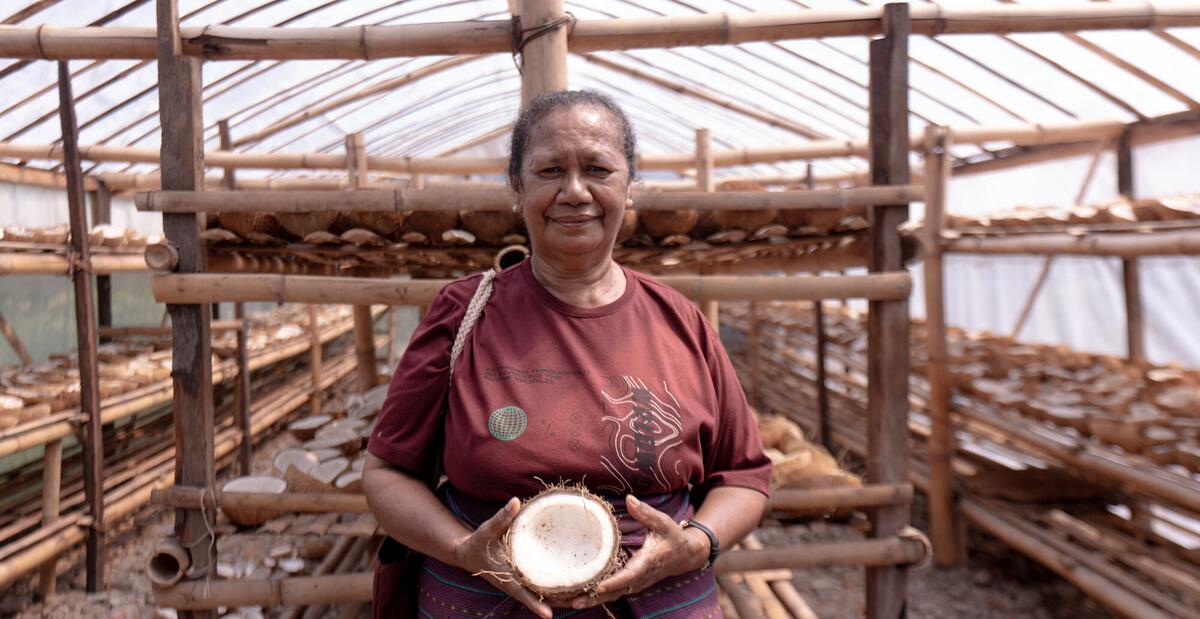
Indonesia: Mama Len in the Solar Dryer House which helps to transform coconut shell waste into high-quality, export-grade charcoal and briquettes that are eco-friendly and energy-efficient. Photo: Kyo Umareta/Oxfam. Oxfam acknowledges the support of the Australian Government through the Australian NGO Cooperation Program (ANCP).
Indonesia
Oxfam supports communities in Indonesia to overcome poverty and inequality.
Because of its largely coastal population and unique geography, our neighbours in Indonesia are living in one of the most climate-vulnerable nations on earth. Rising seas, floods and extreme storms are putting millions of lives (and livelihoods) at risk — especially in rural and coastal areas.
But Indonesians are also learning how to prepare and adapt. When you donate for Indonesia, you’re backing communities who are taking action before the next climate emergency.
Oxfam works alongside local partners to strengthen disaster preparedness, promote gender-just renewable energy, and support people to adapt to a changing climate without losing their cultural identity. Together, we’re helping build safer, more just futures across the archipelago.
Why your support matters in Indonesia
Indonesia sits on the frontlines of the climate crisis. Rising seas, floods, landslides and droughts are reshaping daily life. These extreme weather events are increasing in frequency and severity, threatening homes, livelihoods and lives.
At the same time, World Bank data shows that over 9.5% of Indonesians still live below the national poverty line, making recovery from disaster even harder.
Families lose income, education and access to clean water when storms destroy crops or floods isolate villages. And women often carry the heaviest load while they balance unpaid care with rebuilding efforts.
Yet, amid these challenges, communities are taking the lead. Local organisations are establishing early-warning systems, building renewable energy networks and helping neighbours adapt.
That’s why Oxfam works with Indonesian partners to strengthen these locally led solutions — helping to turn resilience into real, lasting change.
How Oxfam is working in Indonesia
Oxfam collaborates with local organisations across Indonesia to help communities prepare for climate shocks, strengthen adaptation, and build renewable energy systems. Our focus is long-term change that keeps people safe, informed and in control of their futures.
Supporting women-led energy transitions
Through the WE JET Indonesia (ANCP) program, we’re supporting gender-just energy transitions. In rural provinces, women are mapping local renewable-energy potential and devising ways to lead the transition. The program builds energy literacy and access to resources that reduce poverty, cut emissions and strengthen gender equality.
Oxfam acknowledges the support of the Australian Government through the Australian NGO Cooperation Program (ANCP).
Key focus areas

Climate Justice
Working with local partners to secure just climate action and amplify Indonesian leadership on the global stage.

Gender Justice
Supporting women’s leadership in renewable energy, disaster planning and local governance is transformative.

Economic Justice
Expanding access to clean, community-owned power builds both opportunity and resilience.

Community-led Natural Resource Governance
Strengthening local knowledge, early-warning systems and sustainable livelihoods helps communities thrive in changing climates.
Focus on climate action
Indonesia is shaping climate preparedness in South-East Asia. They have expanded early-warning networks to more than 5,000 villages, linking real-time rainfall data with actionable, community-led response plans. But with 261 million people living across 17,000 islands, climate adaptation is a mammoth undertaking.
Oxfam works within this national effort to help partners connect preparedness with long-term climate justice — from renewable-energy access through to disaster-risk training that ensures women and marginalised groups are part of every decision.
Each advance in early-warning science or clean-energy access strengthens the same goal: communities leading the transition to a safer, more just and more sustainable future.
Why choose Oxfam
We work alongside local Indonesian leaders and organisations who understand the challenges and the solutions. When you support Oxfam with a donation for countries like Indonesia, you’re backing:
Local partnerships
Every program is grounded in community knowledge and led by local organisations.
Long-term resilience
From climate advocacy to disaster preparation, we focus on lasting impact (not just emergency relief).
Proven accountability
As a member of the Australian Council for International Development (ACFID), Oxfam follows the highest standards of transparency and effectiveness.
A regional approach
Our work in Indonesia is part of a wider strategy, ensuring solutions are shared, connected and led by the Asia-Pacific region itself.
Justice over charity
We support communities to lead their own future. It’s not about charity. It’s about fairness, dignity and equal rights.
How your donation helps
Your donation to Oxfam supports community-led programs in Indonesia. Here’s what your support can help make possible:
- Stronger disaster preparedness — through community-led planning, early warning systems, and local training
- Support for women leaders — especially in climate advocacy and community organising
- Access to clean water and sanitation — critical during disasters and for long-term health
- Local climate solutions — like food security programs, sustainable livelihoods, and community education
- Stronger regional advocacy — helping communities amplify their voices on the global stage
Your donation is more than a moment of support. It’s a commitment to a more just and resilient future.
Donate to countries like Indonesia now
Help us work for justice and equality. For the right to earn a reliable income and have access to safe water and a viable food network (especially as climate shocks occur more frequently).
By donating today, you can back the leadership of Indonesian communities facing climate extremes head-on. Every contribution helps provide practical tools, long-term support, and builds better systems for the future.
Donate now to support climate action in Indonesia and around the world.
Learn more about Oxfam’s work in the region
Want to understand the bigger picture? Explore how Oxfam works across the Asia-Pacific region to support community-led climate action and push for global systems that put justice first.
Discover Oxfam’s climate justice work. Read about how we’re working with partners across the globe to support more just climate solutions. Or learn more about what climate change is — what’s driving the climate crisis, who it affects most and how you can help.
You can explore our current appeals or learn more about how we work in the Philippines, Bangladesh and Solomon Islands.
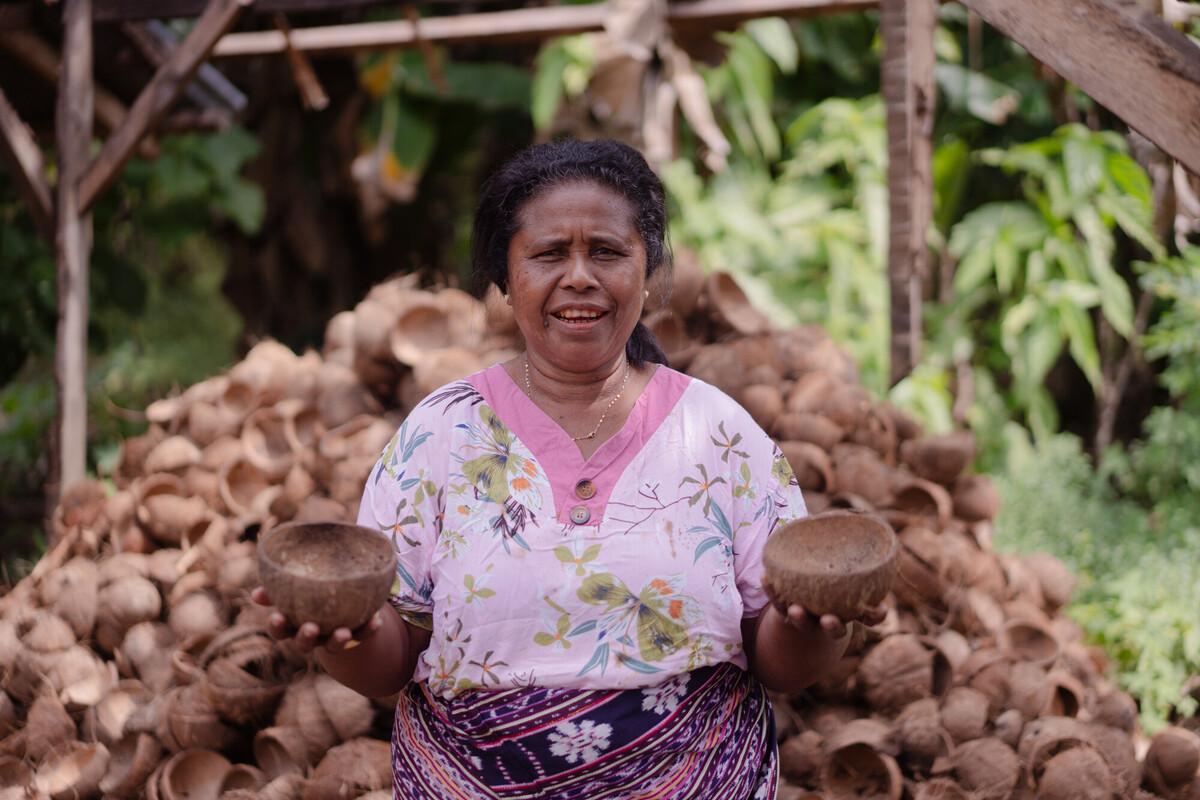
Indonesia: Mama Dalu is a community member who transforms coconut shell waste into white copra briquettes. Photo: Kyo Umareta/Oxfam. Oxfam acknowledges the support of the Australian Government through the Australian NGO Cooperation Program (ANCP).
Donate to support countries like Indonesia
Help us work for justice and equality in Indonesia and around the world. By donating today, you’re backing the leadership of Indonesian communities who are shaping their own future.