Investigations by environmental NGO Greenpeace East Asia have uncovered serious environmental degradation, including high concentrations of heavy metals, in Chinese manufacturing centres Xintang and Gurao.
Both cities are known as success stories in China’s export oriented economy. Xintang is referred to as the “Blue Jeans Capital of the World”, producing 260 million pairs of jeans each year. Gurau is nicknamed “Capital of Sexy” with its annual production of bras at around 200 million.
But success for these cities has come at a high cost to their river ways. Independent laboratory tests have revealed heavy metals such as copper, cadmium and lead in 17 of 21 samples of water and sediment from Xintang and Gurao. One sediment sample from Xintang contained cadmium at concentrations 128 times in excess of national environmental standards. Cadmium exposure has been linked to lung disease, kidney disease and some forms of cancer.
Greenpeace argues that the dirty industrial processes involved in dyeing, washing, bleaching and printing fabrics have all contributed to the high levels of toxicity in waterways. They are calling on China to enact tighter regulations and compliance measures in order to curb polluting practices, such as dumping waste water into rivers.
Industry analysts also argue that a clean-up of the country’s garment sector could save millions of dollars and conserve precious resources. According to global production and sourcing expert Leonie Barrie, if just 100 small to medium-sized textile mills implement basic environmental improvements, China would save more than 16 million metric tons of water annually—enough to provide 12.4 million people with drinking water for a year.
The Chinese garment industry is not alone in its environmental woes. Cases of water pollution across the international textile sector are common, with recent cases in Mexico, India and Indonesia. But China—known as the “factory of the world”—dwarfs manufacturing elsewhere with 133 major industrial textile clusters throughout the country.
“We also hope that consumers will join us in pushing for change from the government and their favourite clothing companies,” says Greenpeace toxics campaigner, Mariah Zhao. “It would be tragic if fashion and economics comes at the cost of China’s clean water resources.”
Watch Film: Textiles pollute China’s rivers
Visit Greenpeace Campaign: The Dirty Secret behind Jeans and Bras
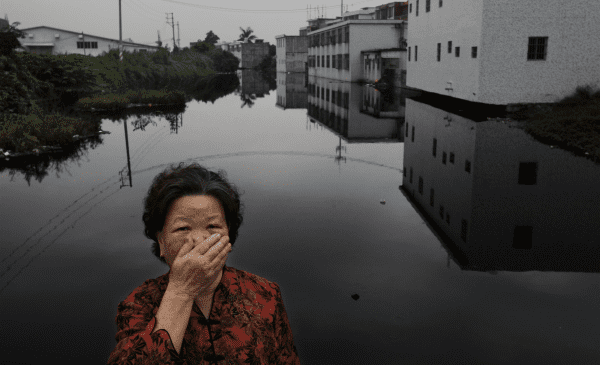
Image: Local Woman in Guangdong Province (Courtesy of Qiu Bo/Greenpeace 06/05/2010)
“We don’t ever dare to open our windows, it stinks too much,” this woman from Ximei Village tells Greenpeace. “And there’s a lot of mosquitos here – big ones, too.” Ximei Village is right next to the Xiao Xi river, into which many factories in Gurao, Shantou, discharge their wastewater. In Gurao, where the economy is centered around textile production, Greenpeace has found high levels of industrial pollution and has documented the effects on the community.
© Qiu Bo / Greenpeace