One of our areas of work in the Mekong Region is ‘Hydropower and Gender’. But what does the construction of dams have to do with gender relations?
Good question.
I asked myself the same thing when I started my experience with Oxfam. Not because I didn’t appreciate working towards gender equality, but because I couldn’t see the connection between hydropower and gender. Later I found out that there was one, and it was striking.
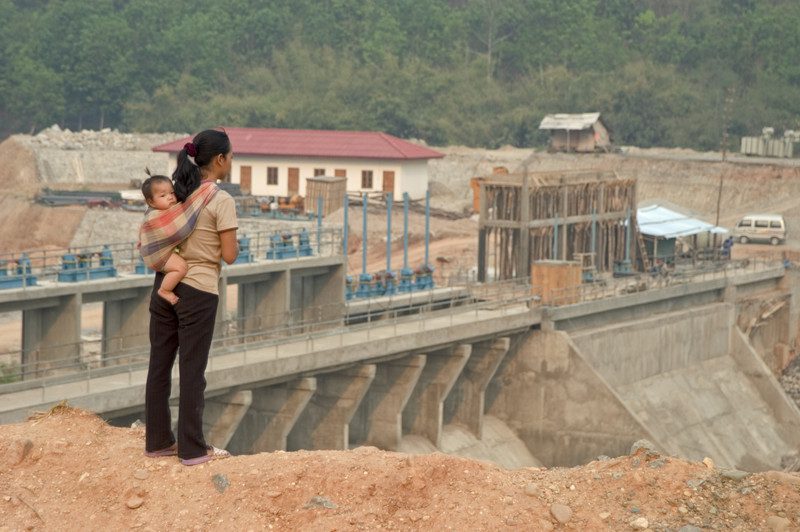
Imagine being a woman living in a community impacted by a dam. First, at relocation time, you are going to lose your home. But it doesn’t end here. Most likely you are going to lose most of the support that came from your husband’s work. He fished in the river and harvested the land irrigated by it. Now all that is gone. The company that built that dam has promised a new home but the recently cleared land is sandy and there is no water. If your husband is ‘lucky’ enough to be employed at the dam construction site, he will bring home some cash.
But, as we have seen, this is not enough to cover your new costs since life in the new location has become much more expensive. Besides taking care of the household, the children, and the livestock, you will also have to find a way to bring home more food to your family.
The impacts from the construction of a dam on women are numerous and vary according to the different relocation sites. What is certain is that, while the construction of a dam is often a catastrophe for anyone in the community, the effects on women is more severe than those suffered by men.
As the Word Commission on Dams Report notes, they will pay a ‘disproportionate share of social costs’.
Currently the dam projects only include generic and superficial consultation with the impacted communities. The consultations do not focus on hearing and addressing women’s concerns, even though they are suffering the most from it. This should make us wonder whether women in hydropower companies, financial institutions, and the governments of the region have an equal say on how the projects, and the consultations, are designed.
Let’s take the example of the Xayabury Dam, which is currently being built in Laos by Thai companies with Thai financing. The construction company, Ch-Karnchang Public Company Limited, has a board of directors composed by 12 members, all men.
Similarly, Krungthai Bank, a Thai public financial institution supporting the dam, has only two women out of 11 members on the Board of Directors. And the Lao government? Not surprisingly, the vast majority of high government positions, including the Ministry of Energy and Mines, are occupied by men. Clearly women do not have much influence over decision making in the hydropower business.
After realising this, questions and doubts naturally followed. What would happen if women participated equally in the design of these projects? Could there be a better understanding that these projects exacerbate gender inequalities? Would they care enough to implement strategies aimed at reducing this issue? Or it would make no difference at all?
These are questions that we need to ask out loud.
Not to suggest a specific solution to the problem—I personally doubt that having more women in high ranking position would alone solve this problem—but rather to provoke a conversation. My hope is that this conversation would eventually shake decision makers from their ivory towers and make them start considering the effect of dams on women.
Written by guest blogger Robin Narciso
Take action now to call for a 10-year moratorium on any dams along the Mekong.