Last updated: November 2026
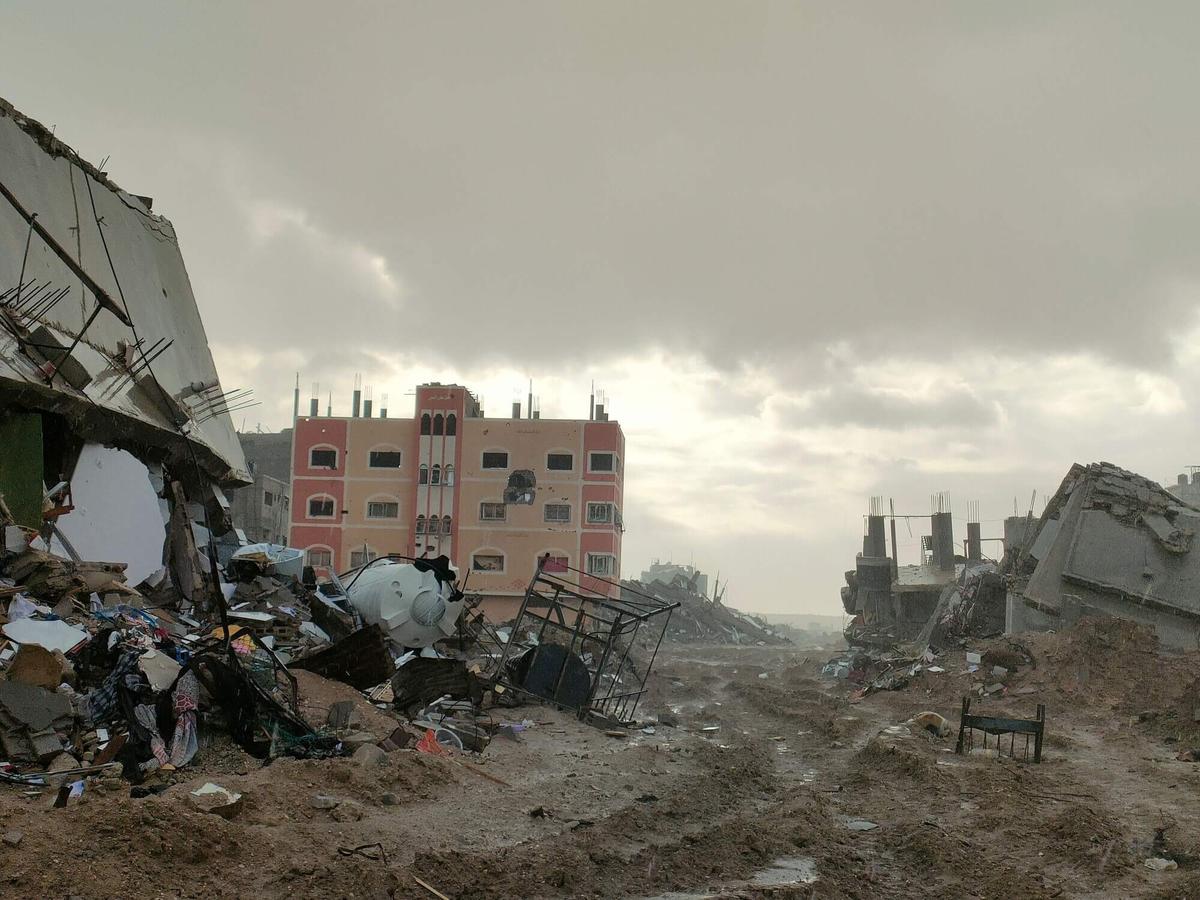
What’s happening in Gaza is a humanitarian crisis marked by starvation, repeated forced displacements, and the destruction of life-sustaining infrastructure and systems (including hospitals and water networks).
More than two years on from the start of the conflict, the Israeli Government has intentionally created a chronic shortage of food, water, medicines and basic services like healthcare across Gaza. Palestinian civilians are living with mass displacement, acute food insecurity, damaged water systems and severe restrictions on aid.
The October 2025 ceasefire was a critical step. But it hasn’t ended the crisis. This article explains the current situation in Gaza, why aid is still being blocked, how Oxfam is responding, and what you can do to help.
What is the Gaza Strip?
The Gaza Strip is a narrow coastal territory of around 365 square kilometres (roughly 45 kilometres long and between two and five kilometres wide) bordered by Israel, Egypt and the Mediterranean Sea.
Before October 2023, around 2.3 million people lived there, making it one of the most densely populated territories on earth. That density is why the crisis has unfolded at such a devastating scale.
What’s currently happening in Gaza?
Figures in this section are sourced mostly from Oxfam’s September 2026 operational reporting, as well as OCHA June 2026 and the IPC July 2026 assessment. This module is updated quarterly.
Ceasefire and current status
A fragile ceasefire came into effect on 10 October 2025. Its first phase included an end to active hostilities, the release of hostages and detainees, and allowing increased humanitarian aid into Gaza.
The ceasefire brought limited relief, but it hasn’t ended the humanitarian crisis. As of September 2026, conflict incidents across the Gaza Strip remain at their highest sustained level since the ceasefire began, with weekly incident totals close to 300, including Israeli airstrikes and ground fire across the Strip. Restrictions on access to 65% of Gaza’s land continue to limit where humanitarian organisations can operate. A ceasefire is not the same as safety or recovery.
Displacement
Most of Gaza’s population remain displaced, living in overcrowded sites or damaged buildings with minimal services, according to OCHA (June 2026). Many families have been forced to move multiple times.
As the rainy season approaches, 464,402 people are living in displacement sites at high risk of flooding, where worn-out tents, poor drainage and limited heating are creating serious health and safety risks.
Food insecurity
The IPC’s most recent assessment (July 2026) found all five of Gaza’s governorates at Crisis level or above. 212,000 people are in Emergency; that’s one step below famine. The IPC describes the gains made during the early ceasefire period as fragile and at risk of rapid reversal.
Prices also remain more than 200% above pre-October 2023 levels, and funding shortfalls are expected to force significant reductions in hot meal programmes and food parcel distributions from October onwards.
The IPC uses a five-phase scale: Phase 3 is Crisis, Phase 4 is Emergency, Phase 5 is Catastrophe or Famine. No area of Gaza is currently below Phase 3.
Water and sanitation
Clean water is one of the most acute needs in Gaza. Damage to water networks and critical shortages of spare parts and fuel have pushed water production from southern Gaza’s two main desalination plants to their lowest levels on record. The damage threatens drinking water supplies for around 500,000 people in Deir al-Balah and Khan Younis. As a result, 74% of the population now relies on water trucked to them rather than supplied through functioning infrastructure.
Oxfam and its local partners are delivering nearly 25,000 cubic metres of drinking water every day through more than 3,000 collection points across Gaza. This is emergency infrastructure built in conditions of extreme constraint.
Health
Severe shortages of essential medicines, including cancer treatments, dialysis materials and insulin, are disrupting life-saving care across Gaza. Some diagnostic services have been suspended entirely; CT scans and mammography are no longer available at Al-Ahli Hospital.
Where water and sanitation systems have broken down, disease risk is rising sharply. Overcrowding and contaminated water are driving increases in acute watery diarrhoea, bloody diarrhoea and acute jaundice.
Women and girls face particular health risks. Oxfam and partners are providing sexual and reproductive health services, psychological first aid and menstrual hygiene support in displacement sites across the Strip.
Why people can’t get the help they need
The barriers to aid in Gaza are solvable. Each of the following constraints has a known solution; what’s missing is the political will to implement it.
1. Unpredictable and restricted ground access
Land crossings are the only scalable way to move life-saving aid into Gaza. Air and maritime routes can add to deliveries, but they can’t replace land access.
In September 2026, the Egypt corridor (the primary route) suffered significant disruptions, while the Jordan corridor remains blocked entirely. Humanitarian missions continue to face denials, delays and movement restrictions.
What would help: Principled, safe, unimpeded and sustained humanitarian access across all crossings, coordinated through a UN-led mechanism grounded in international law.
2. Fuel scarcity
Fuel is essential for hospitals, water systems, food distribution, logistics and telecommunications. Prolonged restrictions on fuel entry can have widespread, deadly consequences.
What would help: Regular, sufficient fuel deliveries for humanitarian operations and civilian infrastructure.
3. Restrictions on critical items and repairs
Aid agencies are limited as to how much essential equipment and spare parts they can bring in (if any), which are needed to restore water, sanitation and hygiene (WASH) services. Southern Gaza’s desalination plants are operating at their lowest levels because the parts to fix them cannot get through.
What would help: Authorisation for urgently needed water, sanitation and health items and repair materials, with clear and consistent approval processes.
4. Insecurity and damaged infrastructure
Damaged roads, debris and ongoing security incidents impede aid truck movements and delay distributions. Humanitarian operations are repeatedly curtailed by access denials and the risks to aid workers and convoys.
What would help: Sustained adherence by all parties to international humanitarian law, safe movement for aid workers, and clearance of main logistics routes.
5. Communications and coordination gaps
Limited connectivity and telecommunications outages make it harder for aid organisations to coordinate, track convoys and assess where needs are greatest.
What would help: Reliable power and telecommunications for humanitarian operations, and streamlined, transparent coordination between agencies.
6. Underfunding
Humanitarian plans for the Occupied Palestinian Territory have been significantly underfunded, constraining the scale of the response right when needs are high.
What would help: Timely, flexible funding that matches the scale and duration of needs so organisations can procure, staff and deliver at pace.
Oxfam’s response in Gaza
The Oxfam confederation is working with Palestinian partners to deliver WASH support, essential supplies and cash assistance in the face of huge obstacles, while advocating for safe, sustained humanitarian access. What does that look like?
Since October 2023, Oxfam and its local partners have reached more than 1.74 million people across Gaza and the West Bank. In September 2026, we made 843,597 assistance contacts in Gaza alone, delivering water, food, hygiene and protection support through our local partner network.
Water, sanitation and disease prevention
Working with Palestinian partners, Oxfam is delivering water, installing desalination units, rehabilitating water supply points, distributing hygiene kits and running sanitation services across displacement sites.
In September 2026, Oxfam and partners installed 563 latrines across 13 displacement sites, conducted more than 450 hygiene awareness sessions and delivered over 41,000 cubic metres of water across North, Middle and South Gaza.
Food security and livelihoods
Oxfam and partners are distributing food parcels and vouchers, supporting small-scale farmers, providing cash assistance and helping to rebuild agricultural infrastructure, including irrigation systems and support for the 2026 olive harvest season. Cash assistance reaches families when markets are functioning enough to allow it.
Protection and support for women and girls
Protection can’t be an afterthought in a crisis this severe. Oxfam and partners are providing psychosocial support, gender-based violence case management, legal assistance and sexual and reproductive health services to women and girls in displacement sites across Gaza.
We are also engaging men and boys, and establishing young women’s leadership committees. Long-term recovery requires women’s full and equal participation in rebuilding their communities.
Working through local partners
Everything Oxfam does in Gaza is done in partnership with Palestinian-led organisations already embedded in their communities. This is a highly effective way to deliver aid, and it’s the only way to build the local leadership that sustainable recovery depends on.
What needs to change
It is not just about what is happening in Gaza, but what needs to change. To protect civilians and enable an effective humanitarian response, Oxfam is calling for:
- Full implementation of the ceasefire, including unrestricted aid access and Israeli army withdrawal from occupied territory.
- Full, safe and predictable humanitarian access via all possible routes and crossings, with adequate fuel and relief supplies allowed in daily and in sufficient quantities to meet needs.
- Protection of civilians and aid workers, and respect for international humanitarian law, including the protection of medical facilities, water and sanitation systems, and humanitarian personnel.
- Removal of impediments on UN agencies and humanitarian organisations, so assistance can be delivered at scale and in line with humanitarian principles.
- Adequate, flexible funding for the humanitarian response and for early recovery, channelled to organisations operating on the ground and to local partners.
How you can help
The crisis in Gaza is urgent, and there are things you can do right now.
Donate
Your donation to Oxfam’s Gaza Crisis Appeal funds clean water, food assistance, hygiene kits and protection services, delivered through local partners on the ground. Every contribution helps us reach more people.
Take action
Use your voice. Reach out to your local MP or senator and ask them to push for full ceasefire implementation and unrestricted aid access into Gaza. You can also help by sharing accurate, up-to-date information about the crisis with your friends, family and networks.
Stay informed
Read Oxfam’s Gaza crisis updates for the latest on conditions on the ground and how we’re responding.
FAQ: What’s happening in Gaza?
What is the Gaza Strip?
The Gaza Strip is a narrow coastal territory of around 365 square kilometres, bordered by Israel, Egypt and the Mediterranean Sea. Before October 2023, around 2.3 million people lived there, one of the highest population densities anywhere on earth. The scale of the humanitarian crisis is in part because of that population density.
How many people have been displaced in Gaza?
Most of Gaza’s population (which was 2.3 million people in 2023) remain displaced as of May 2026, according to OCHA. Many families have been forced to move multiple times, sheltering in overcrowded sites or damaged buildings with minimal access to water, food or healthcare.
Is aid getting into Gaza?
Aid is reaching Gaza, but at levels far below what is needed. The Egypt corridor is the primary route, but it suffered major disruptions in September 2026. The Jordan corridor is currently blocked. Restrictions on access to 65% of Gaza’s land mean aid organisations can only operate in areas that are already severely overcrowded. Oxfam and partners are delivering water, food and hygiene supplies daily, but the barriers are severe and ongoing.
Is there a ceasefire in Gaza?
A fragile ceasefire came into effect on 10 October 2025. But conflict incidents remain at their highest sustained level since the ceasefire began, large areas of Gaza remain inaccessible, and the humanitarian crisis is ongoing. A ceasefire is not the same as peace or recovery.
How can I help people in Gaza?
You can donate to Oxfam’s Gaza Crisis Appeal to fund water, sanitation and hygiene, food, and protection services on the ground. You can speak up and call on decision-makers to implement the ceasefire fully and restore humanitarian access. And you can stay across the latest updates to keep informed and share verified information about what is happening.