How does donating to charity help, and do charities actually work? These are fair questions. Research from Equity Trustees found that 96% of Australians gave to a charity they felt aligned with last year.
Clearly, most of us want to give. What people want to know is whether it helps. We wrote this guide to take you through the evidence, learning where giving can fall short and what effective, accountable giving looks like.
So, does giving to charity actually work?
Yes, giving to charity works, but with important caveats. A charity’s effectiveness varies enormously between organisations, depending on transparency, accountability and the use of targeted, evidence-based interventions.
What charity programs work?
The World Bank’s Independent Evaluation Group finds the evidence is strongest for direct, targeted programs such as clean water access, emergency food relief and health services.
Whether large-scale international aid (billions of dollars flowing into countries over many years) actually causes those countries’ economies to grow is something economists and researchers sometimes disagree about. Some say yes. Others are more cautious, or suggest the relationship is more complicated than a simple cause and effect. There’s no settled consensus.
This is different from asking whether a specific program works — clean water for 4,650 people, emergency food relief for displaced families. The evidence for specific interventions is much stronger, with programs typically generating more value than they cost to deliver.
How does it affect the person giving?
The 2025 World Happiness Report found that being generous is strongly associated with, and often directly causes, increased wellbeing among givers across cultures. The report describes giving as “twice-blessed” because it benefits both those who give and those who receive.
A recent study across 207,919 people in 22 countries found charitable giving was prospectively associated with improved psychological wellbeing, stronger social connections and greater life satisfaction (meaning charitable giving came before those benefits). It’s clear: giving to others can help you feel better about life.
The caveats
Impact can vary between organisations. Reputable charities publish a breakdown of how donations are used and what proportion reaches programs directly. Get familiar with those pages and reports. You can only know whether charities actually help by knowing about the particular organisation you’re donating to.
So, is donating to charity worth it? Well, that brings us to what makes giving effective in the first place.
What makes some charities so effective?
Understanding why some giving works better than others helps you make your decision confidently. Three things consistently distinguish effective charitable interventions from ineffective ones.
Strongly evidence-backed
Effective charitable interventions must be built on strong evidence. Look for independent evaluations and documented outcomes, signs that the organisation measures and reports their impact thoroughly and honestly.
Transparent and accountable
Look for organisations that publish audited financials and detailed program breakdowns. If a charity is doing good work, it should be able to show you exactly where the money goes. Accountable charities that make a measurable difference welcome your questions.
Specific, targeted interventions
The most effective programs are highly specific and targeted to what communities actually need. When an intervention is well-targeted and community-led, the benefits ripple outward. Better water access improves child health, which improves school attendance, which improves long-term economic participation.
Red flags to watch out for when choosing a charity
High overhead and administrative costs
Does the charity spend significantly more on administration and fundraising than on programs? Overhead ratios aren’t the only measure of effectiveness, but extreme imbalances are a signal.
Lack of accountability and impact measurement
Charities that can’t demonstrate measurable outcomes, won’t publish audited financials, or resist independent evaluation are harder for you to assess. Accountability is how you verify your donation is working.
Programs that ignore community needs
Sometimes good intentions lead to harmful interventions. Programs designed around what donors want to give, rather than what communities actually need, have a documented history of poor outcomes (and sometimes cause harm).
Sending goods that aren’t needed, for example, or flooding local markets with free imports, can undercut the local economies communities depend on. The most effective programs are designed with community input and driven by local leaders.
How to verify a charity’s impact
There are several ways you can assess whether a charity is effective, transparent and accountable.
Use independent evaluators
There are organisations that evaluate charities’ effectiveness and financial health, each with a different focus:
- ACNC Charity Register is Australia’s official charity regulator. It confirms registration, financial filings and governance for all Australian charities
- Charity Navigator assesses financial health, accountability and transparency; it’s primarily US-focused but internationally relevant
- GiveWell does rigorous cost-per-outcome analysis, primarily focused on global health interventions
Different evaluators use different methodologies. Some focus on health metrics, others on financial transparency or development programs. Using more than one gives a fuller picture, and no single evaluator covers every type of charitable work.
Check financial transparency and overhead ratios
Verify that a charity publishes audited annual reports with detailed program breakdowns that distinguish program costs from administration and fundraising. If you read about our impact at Oxfam Australia, you’ll see that 67c from every $1 goes to life-changing work, while at least 90% of emergency appeal funds go directly to emergency response. See the full breakdown of where the money goes.
Look for sector accreditation
ACFID membership requires compliance with a code of conduct covering ethics, accountability and development effectiveness. DFAT accreditation is a government-assessed process confirming an organisation has the systems and capacity to deliver quality development outcomes. Oxfam Australia holds both.
Donate directly through official channels
Verify a charity’s official website through the ACNC Charity Register before donating, and always give through the charity’s own website rather than third-party collectors or crowdfunding pages.
Where charitable giving makes the biggest difference and what Oxfam does
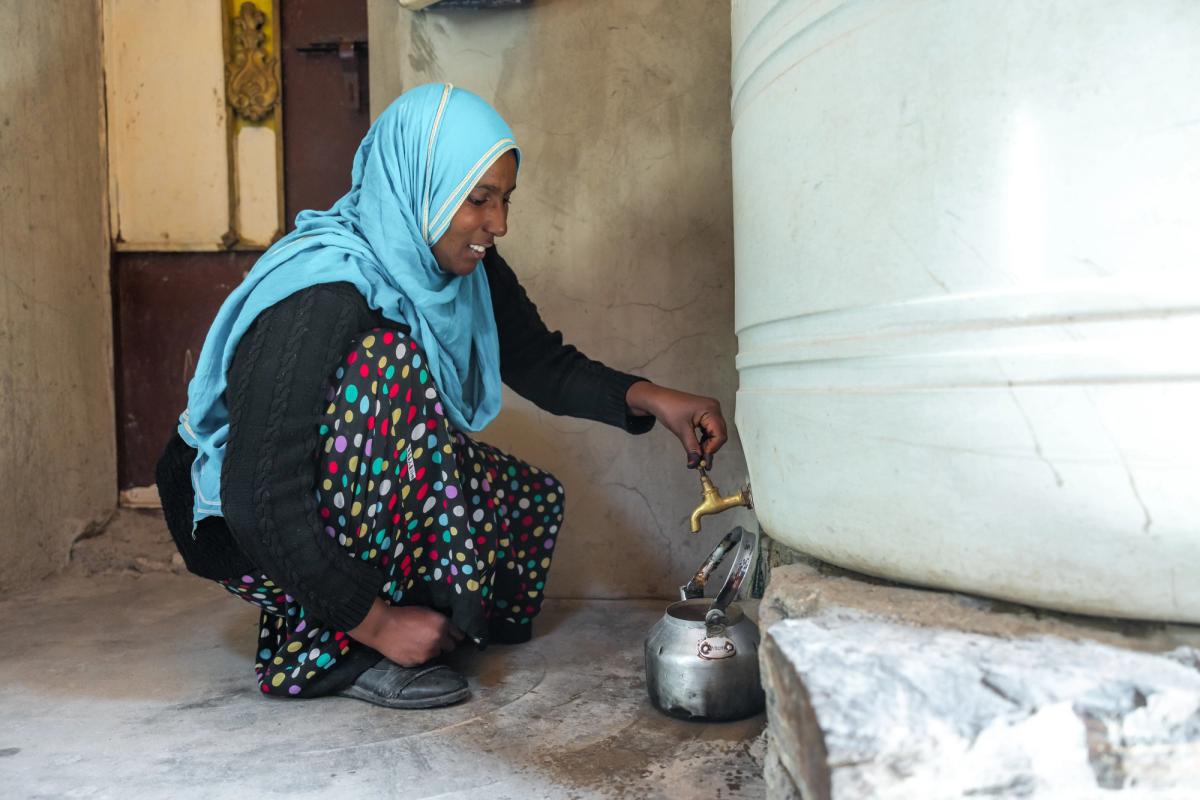
Yemen: In front of a dedicated water tank for drinking and cooking, Rawya’s joy is unmistakable. She carefully pours fresh water into her pot, savoring the simple yet profound convenience. Photo: Ahmed Al-Basha/Oxfam
Emergency relief
When crisis strikes, immediate access to clean water, food, shelter and sanitation saves lives. In Lebanon in 2026, Oxfam reached 8,460 displaced people in 40 collective shelters with water trucking and hygiene and baby kits. It was part of a wider response reaching communities across Beirut, Mount Lebanon and North Lebanon. Across 2024-25, Oxfam Australia’s work contributed to the Oxfam confederation reaching 14.25 million people in a time of crisis.
Long-term development
Long-term development programs that tackle the root causes of poverty can create lasting change. In Yemen, which is in the thick of a water crisis, a solar-powered water system now serves 4,650 people in Farjat Adeem.
Reliable local access to clean water has freed women and children from hours of daily water collection and reduced waterborne disease. Research shows that when women and girls are freed from water collection, they’re more likely to stay in school and work.
This is the economic multiplier: one intervention, designed with the community, generating benefits across health, education and economic participation for years.
Advocacy and systemic change
Some of the highest-impact charitable work is the least visible: policy change and institutional reform.
In the Pacific, Oxfam supports community climate networks across Tuvalu, Kiribati, Fiji, Solomon Islands and Vanuatu to represent Pacific voices in regional and global climate negotiations. The communities most exposed to climate change must have a say when decisions are made.
Systemic change is harder to measure per dollar than a water tank, but policy shifts and institutional reform can create conditions that benefit entire populations — including people and communities that direct aid programs may never reach directly.
Explore Oxfam Australia’s current appeals or donate today.
The tax benefits of donating to charity
For Australian donors, donations of any amount to a registered Deductible Gift Recipient (DGR) may be claimed as a tax deduction, reducing your taxable income for that financial year. The actual saving depends on your marginal tax rate and individual circumstances.
Oxfam Australia is a registered DGR. For an estimate of your potential savings, use Oxfam’s tax calculator. For advice specific to your situation, speak to a registered tax adviser or visit the ATO’s guidance on gifts and donations.
Tax is a real benefit of giving to a registered charity, but as Equity Trustees’ research found, only 20% of Australian donors cite it as a primary motivation. For most of us, the reason to give comes first. The tax benefit follows.
How to donate to Oxfam Australia
There are several ways you can give, each suited to a different kind of commitment.
Make a one-off donation
A donation to Oxfam Australia goes to life-changing work. You can choose a specific appeal or let us direct the money where it’s currently needed most.
Become a regular donor
Monthly donations give Oxfam predictable income, which means we can plan long-term programs rather than only react to the latest crisis. It’s one of the most effective ways to give, because it funds sustained work rather than one-off responses.
Give a gift through Oxfam Unwrapped
Oxfam Unwrapped turns gift-giving into something that feels good in every way. Every funny, thoughtful card represents a real donation to Oxfam, helping fund practical tools and long-term work that creates lasting change.
You can also learn about giving through your workplace and leaving a gift in your will.
Donating to charity works when you give well
The question at the start of this article was fair. The answer is yes, donating to charity helps when giving is directed to organisations that are transparent, accountable, and working on interventions with documented outcomes.
Clean water in Farjat Adeem. Emergency support for thousands of displaced families in Lebanon. Community climate networks advocating for the Pacific’s future. Communities that are supported with the tools to change their own circumstances, to reduce poverty driven by inequality.
The question isn’t whether to give. It’s how to give well.