More than four million people in Lebanon depend on public water systems that are now failing on multiple fronts at once.
The country is experiencing its worst drought in 65 years. Then, in March 2026, conflict escalation displaced more than a million people within weeks, and damaged water infrastructure that was already stretched to breaking point.
A 2025 Red Cross study found that 91% of Lebanese households are experiencing moderate-to-high water insecurity. Lebanon’s water crisis doesn’t have only one cause. It’s what happens when drought, economic collapse and conflict all hit the same fragile system at once.
What’s driving Lebanon’s water crisis?
Lebanon’s water shortage isn’t caused by any single factor. It’s the result of several crises compounding each other, each making the others worse.
Drought due to climate change
Lebanon is in the grip of its worst drought in 65 years. Lake Qaraoun, the country’s largest reservoir, received just 45 million cubic metres of inflow during the 2025 wet season, compared to an annual average of 350 million. It’s the lowest level ever recorded.
Less water in rivers and reservoirs doesn’t just mean less water overall; it means the water that remains is more concentrated with pathogens, directly increasing the risk of waterborne disease.
Economic collapse
Lebanon’s economy has contracted by more than 38% between 2019 and 2024, according to World Bank estimates, with the currency collapsing and inflation putting even basic costs out of reach for most households.
This collapse is at the root of the water crisis as much as the drought is. Even before the current escalation, in 2021 UNICEF found that nearly 1.7 million people had access to only 35 litres of water a day, a drop of almost 80% from the pre-2020 national average of 165 litres.
That collapse in household access was driven by economic failure and the parallel collapse of the power grid, years before drought or the current conflict added the pressure it does today.
Power and fuel: the mechanism connecting everything
Lebanon’s water system depends almost entirely on diesel-powered pumps to move water where it’s needed. After years of economic collapse, many households and even regional water authorities can’t reliably afford fuel.
When the fuel runs out, the pumps stop and water stops moving, no matter how much is sitting in the reservoir.
This is why an economic crisis becomes a water crisis: it doesn’t matter how much water exists if there’s no fuel to move it.
Infrastructure and conflict damage
Years of underinvestment due to economic collapse had already left Lebanon’s water network fragile. Then came direct damage from conflict: in the first four days of the March 2026 escalation alone, at least seven critical water sources were damaged, cutting off water to almost 7,000 people in the Bekaa region.
But conflict doesn’t only damage pipes and pumps; it also displaces people. When more than a million people were displaced within weeks in March 2026, many moved toward Beirut and Mount Lebanon, placing sudden extra demand on water systems in those areas that hadn’t been damaged at all.
Displacement is its own driver of shortage: a water system built for one population suddenly has to serve many more.
None of these causes operates alone. A drought that would once have been manageable becomes a crisis when the pumps that move water depend on fuel that families can no longer afford, in a country where conflict can damage what’s left of the system overnight.
This is Lebanon’s water scarcity in 2026: not one disaster, but several, arriving together.
The human cost of Lebanon’s water shortage
When water systems fail, the consequences move quickly from inconvenience to illness, and from illness to deeper poverty.
WHO’s most recent surveillance data for Lebanon (April 2026) recorded 533 food- and waterborne disease cases in a single week, at levels described as ‘elevated’.
A 2025 Waterborne Disease Risk Map identified 85 areas across Lebanon at high risk of disease outbreaks linked to drought-driven water scarcity, and health experts have warned that cholera, eradicated in Lebanon since the 1990s, could become endemic again if conditions don’t improve.
For families who lose access to water, the alternative is private trucked water. In a country where 44–70% of people live in poverty (depending on the region), that’s an impossible burden for many households.
This is poverty driving illness, and illness deepening poverty. Access to clean water can break the cycle.
Where Lebanon’s water crisis is hitting hardest
Lebanon’s water supply is managed through four regional Water Establishments: Beirut-Mount Lebanon, Bekaa, South Lebanon and North Lebanon.
Greater Beirut and Mount Lebanon (home to a large share of Lebanon’s population) are under acute pressure as families displaced from southern Lebanon move toward the capital in search of safety, adding further strain to an already overwhelmed water network.
The Bekaa region has been hit particularly hard, facing both drought-driven agricultural water shortages and direct damage to water infrastructure from the recent escalation.
While Beirut and Bekaa face the most acute pressure right now, every region of Lebanon is in crisis.
Gloria’s story
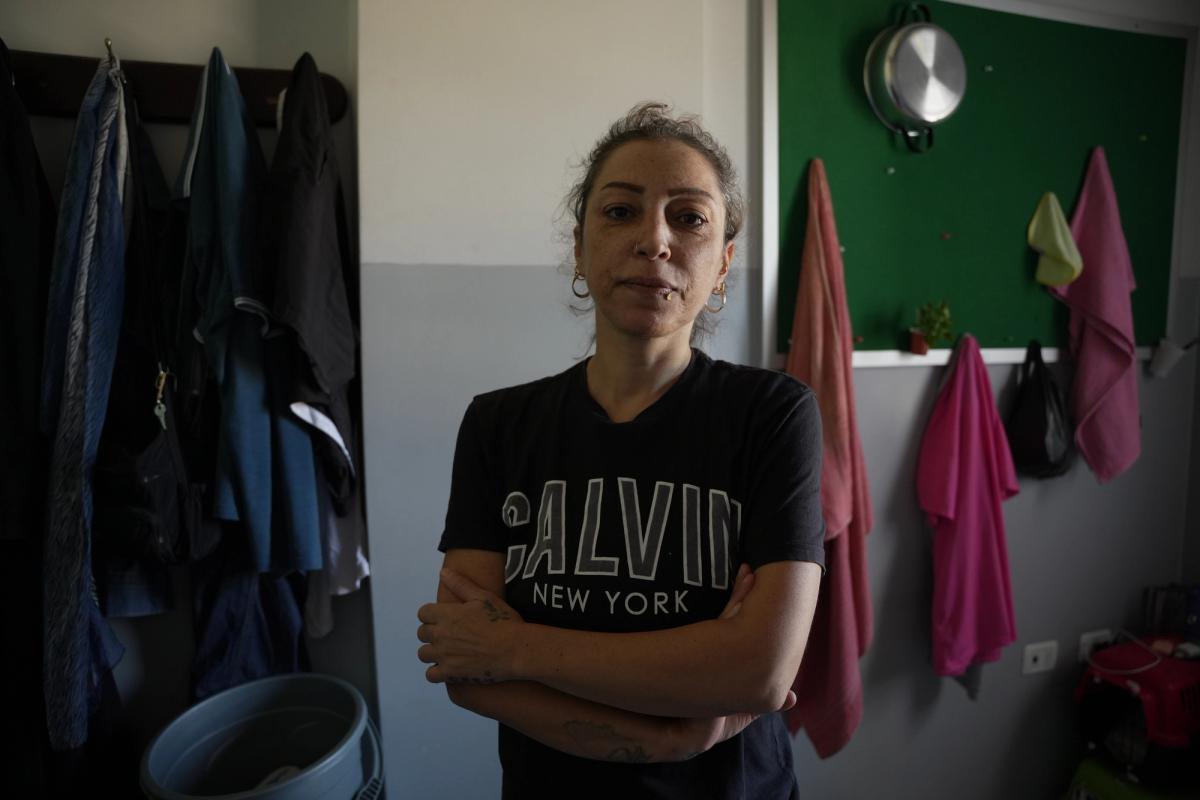
Jabal Mohsen, Lebanon: Gloria was displaced from her home inSouth Lebanon and struggled to find water as she fled to safety.Photo: Jean Hatem/Oxfam.
When the bombs hit her home in southern Lebanon, Gloria had to decide what to pack.
‘What should I take with me? What should I leave behind?’ she says. ‘My dad left on his own, and I don’t know where he is either. We’re all scattered.’
She and her husband loaded their car and left, taking their two cats and a small pot of basil.
‘This is what gives me hope,’ she says, holding it. ‘The scent of the south.’
They ran out of fuel on the road and faced many challenges, but Gloria has since found shelter in northern Lebanon, where the welcome from local communities has moved her. ‘They say, “Don’t say displaced. You’re home here, it’s your country, your land. You’re not displaced. You’re a guest staying with us. And you’re the most welcome, the houses are all yours.”’
Gloria is one of more than a million people forced to leave their homes during the March 2026 escalation. Many, like her, made their way toward Beirut and northern Lebanon, placing sudden, enormous demand on water systems already stretched beyond their limits by years of economic crisis and drought.
How Oxfam is responding to Lebanon’s water crisis
Since 2015, Oxfam has worked alongside Lebanon’s regional Water Establishments (particularly the Bekaa Water Establishment) on water infrastructure restoration and long-term capacity building.
Before Lebanon’s economic collapse in 2019, Oxfam introduced solar-powered water pumping in the country (well before the national fuel crisis made solar power a necessity nationwide). This is a direct answer to a mechanism at the heart of Lebanon’s water crisis: systems that depend on fuel families can’t afford. Solar pumping breaks that dependency and increases a community’s ability to cope with future shocks.
During the March 2026 escalation, Oxfam reached out directly to coordinators across the South Lebanon, Bekaa and Beirut-Mount Lebanon Water Establishments to assess urgent needs and support the continued operation of water services for communities affected by the conflict.
On the ground, Oxfam’s response has reached thousands of displaced people directly.
Across South and Mount Lebanon alone, Oxfam has reached around 8,460 people sheltering in 40 collective shelters; trucking in close to 960 cubic metres of water and distributing hygiene, baby and menstrual hygiene kits.
In Bekaa, water trucking has reached 121 households across five collective shelters, alongside emergency latrines installed in two shelters. This is part of a wider response reaching communities across Beirut, Mount Lebanon and North Lebanon.
This work in Lebanon sits within Oxfam’s broader response across the region, alongside ongoing work in Yemen and Syria. You can read more about the Middle East water crisis.
Help fund the water solutions Lebanon needs (now and for the next crisis)
Support Oxfam Australia’s Middle East Crisis appeal to help provide clean water, hygiene kits, and support long-term restoration of clean drinking water in areas impacted by conflict across Lebanon.
What needs to happen now
Lebanon’s water shortage has a number of causes, and each one has a response that’s already proven to work, but needs to happen at scale.
Build more solar-powered water pumps
Drought reduces the amount of water available. But the bigger problem is that the water that does exist often can’t reach people, because the system that moves it depends on fuel many can no longer afford.
Solar-powered water pumping breaks that dependency. Scaling this up is one of the clearest ways to reduce how much damage the crisis does.
Increase rapid repair capacity
Conflict can damage infrastructure overnight, as it did across the Bekaa in March 2026. What determines how long communities go without water is how quickly that damage can be repaired.
Rapid repair capacity within Lebanon’s regional Water Establishments (the kind Oxfam supported during the recent escalation) is what turns a days-long outage into a weeks-long one, or the reverse.
Increase humanitarian funding
None of this happens without funding. Lebanon’s humanitarian response remains significantly underfunded, and that gap determines how far solar systems, repairs and emergency support can reach. International aid coordination is what makes everything else possible.
We know how to create a different future for Lebanon, but it requires more of us to act. Take action with Oxfam Australia.
Add your voice to call for climate justice
As well as donating, you can help us add collective pressure upon the people who hold significant power to create change.
Sign petitions and contact decision-makers to push the Australian Government to act on climate justice, increase aid investment and hold those responsible for infrastructure destruction to account. Visit Oxfam Australia’s advocacy and campaigns page to add your voice.
You can also learn more about our International Crisis Fund or explore our current appeals.