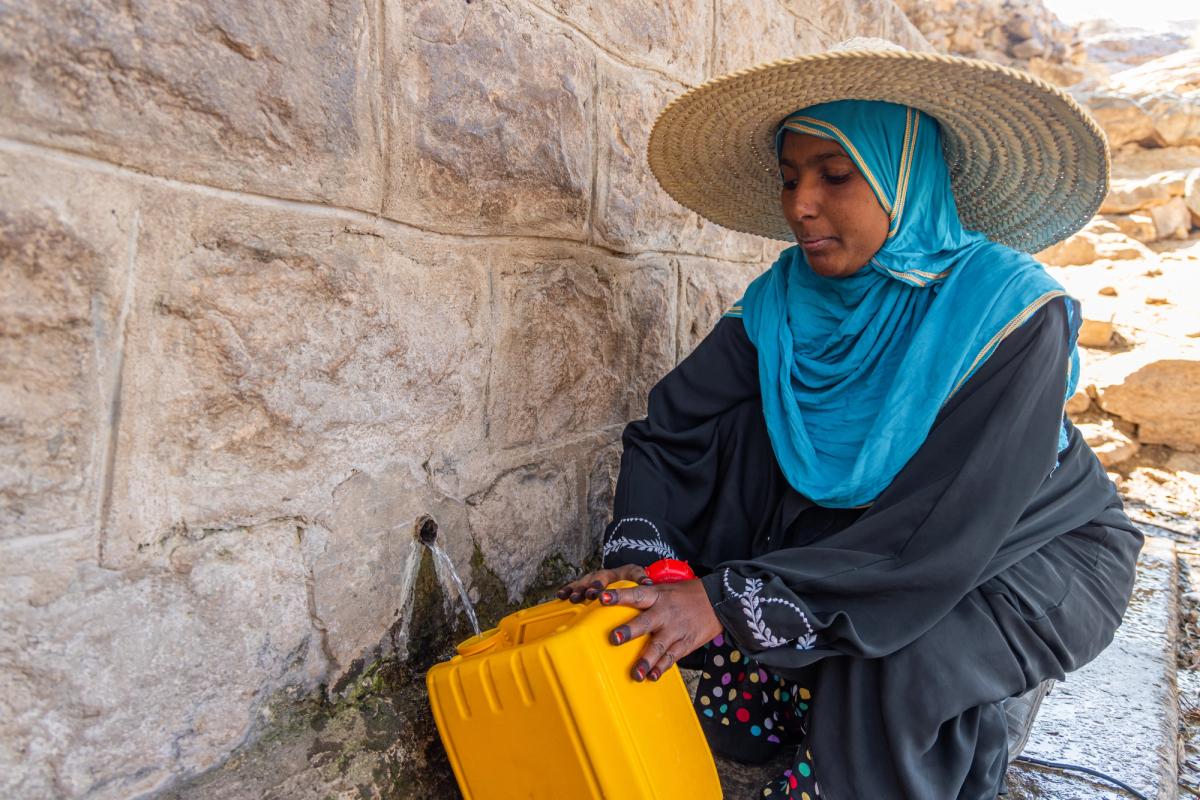
Yemen’s water crisis did not begin with conflict. Long before war came in 2015, Yemen was already one of the world’s most water-scarce nations. A country with a growing population, no permanent rivers and shrinking groundwater reserves.
Conflict then damaged a system with almost no reserves left, destroying infrastructure and displacing communities. Cutting off millions from what access they had managed to build.
Today, more than 17 million people in Yemen, half of them children, lack sufficient access to clean water, sanitation and hygiene services. This is part of a wider pattern of water crisis across the region. Read more about the Middle East water crisis.
What’s driving Yemen’s water crisis?
Yemen’s water shortage is the product of three overlapping crises, each of which would be serious on its own: structural water scarcity, water resource mismanagement and conflict. Together, they are catastrophic.
Structural water scarcity worsening in the climate crisis
Yemen has no permanent rivers. The country depends entirely on irregular rainfall (typically between 108 and 114 millimetres per year) and on groundwater reserves that can’t replenish fast enough to meet demand.
According to Carnegie Endowment analysis, Yemen’s per capita water availability sits at approximately 150 cubic metres per year, compared to a regional average of 1,250 cubic metres across the Middle East and North Africa. Yemen has one-eighth the water per person of its neighbours.
The global threshold that defines water stress is 1,000 cubic metres per capita. Yemen doesn’t come close.
The climate crisis is making this worse. Rainfall is more erratic and less predictable, arriving in short, intense bursts that generate runoff rather than soaking into the ground to recharge aquifers. Rising temperatures increase evaporation from reservoirs and soil, further reducing what little water the land retains.
Structural water scarcity is the baseline in Yemen, before conflict and resource mismanagement add further pressure.
Groundwater depletion and resource mismanagement
Yemen has long used more water than what is replenished. Agriculture accounts for over 90% of Yemen’s total water consumption, leaving barely 10% for domestic and industrial use combined. Thousands of unlicensed wells, inefficient irrigation systems and water-intensive crops (including qat, a stimulant plant widely grown across the Yemeni highlands) have drained groundwater reserves that took centuries to accumulate.
In some areas, groundwater levels are declining at up to 6 metres per year. Yemen’s groundwater is being extracted at twice the rate it can be replenished. In the Sana’a basin alone, 13,000 wells draw from reserves that were already critically low before the current crisis. Without urgent change, the capital could run out of groundwater within a generation.
Conflict and infrastructure destruction
All of this meant that when conflict began in 2015, Yemen’s water system had almost no buffer. Pumping stations, treatment plants and distribution networks were destroyed or abandoned during conflict. The equipment that survived was left without fuel and spare parts as the economy collapsed and supply chains broke down.
Fuel shortages became chronic as the conflict deepened, and because Yemen’s water infrastructure ran almost entirely on diesel, the shortages stopped the water pumping just as effectively as direct damage.
Rising diesel prices and a shortage of spare parts have since left entire communities without functioning water supply systems.
The relationship between water and conflict in Yemen is not one-directional either. Water scarcity also causes conflict: research indicates that 70–80% of all rural conflicts in Yemen are water-related. And conflict destroys water infrastructure, which deepens scarcity, sometimes creating more conflict. One crisis feeds the other. Breaking that cycle is urgent.
Help us provide clean, reliable water to Yemeni communities by donating to our Middle East crisis appeal.
Who bears the heaviest cost of Yemen’s water shortage?
The burden of the water crisis in Yemen does not fall evenly. The people with the least power to change the systems are the ones paying the most.
Women and children
In some rural parts of Yemen, women and girls walk for hours each way to fetch water, often from sources of uncertain quality. This daily burden is a structural inequality. Girls miss school. Women are excluded from education, paid work and community decision-making because hours of every day are consumed by a task that sustainable water infrastructure would eliminate.
Public health
In a country where healthcare infrastructure has been devastated by a decade of conflict, contaminated water kills. Diarrhoea, dysentery and cholera spread through open wells and unregulated water sources, hitting children hardest in communities already weakened by food insecurity and malnutrition.
The food and water crises compound each other: without clean water, food assistance alone cannot prevent malnutrition. Without adequate food, children’s immune systems cannot fight waterborne disease.
Economic strain
For families who can’t rely on public water infrastructure, the alternative is buying water from trucks at prices that have become unaffordable for most. Over 80% of Yemenis now live in poverty. When clean water becomes a commodity that families must purchase, the poorest communities pay the highest price per litre (buying it from a truck) and bear the greatest health risk when they can’t afford to.
This is poverty driving illness and illness deepening poverty. Access to clean water can break that cycle. That’s what Oxfam works toward.
How Oxfam is responding to Yemen’s water crisis
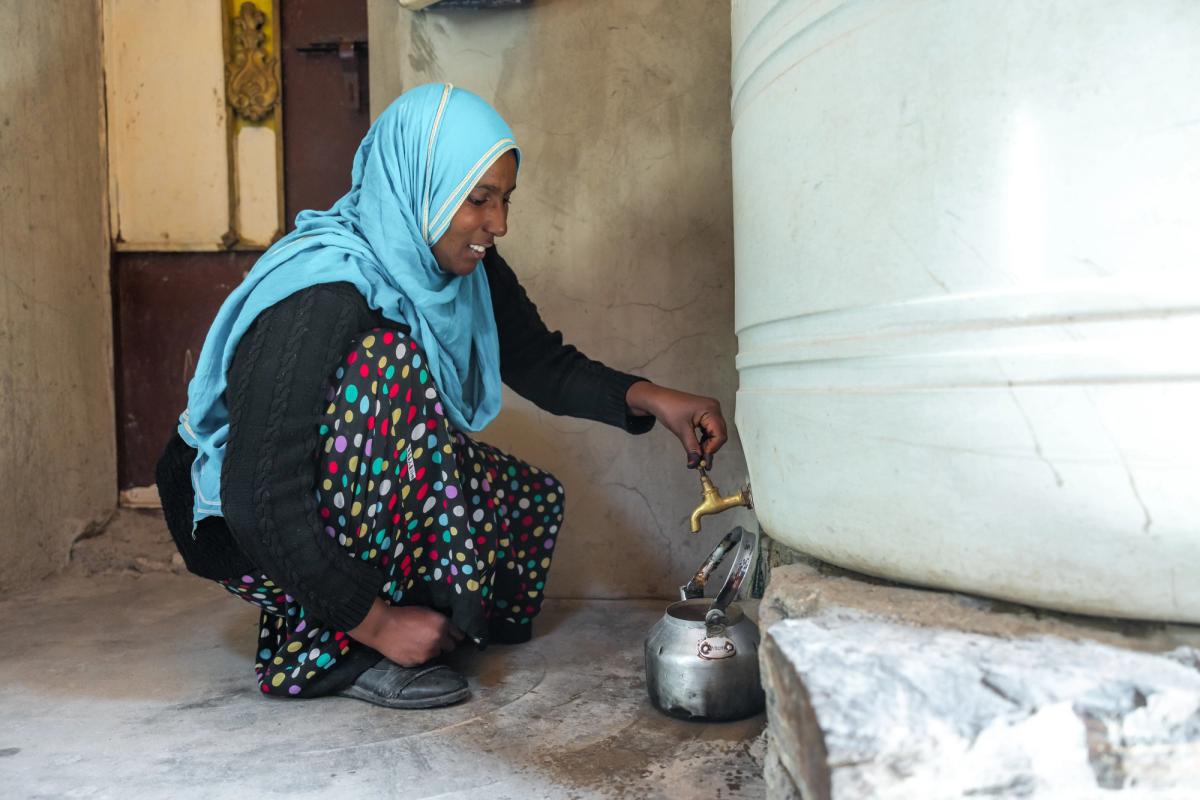
Yemen: In front of a dedicated water tank for drinking and cooking, Rawya’s joy is unmistakable. She carefully pours fresh water into her pot, savoring the simple yet profound convenience. Photo: Ahmed Al-Basha/Oxfam
Oxfam has worked in Yemen since 2015, reaching more than three million people with clean water, sanitation and hygiene support: fixing wells, installing solar water pumps, trucking clean water to camps of internally displaced people and running hygiene programs to slow the spread of cholera. One project in particular shows what sustainable water access can look like in one of the world’s most water-stressed regions.
Rawya’s story: Farjat Adeem, Taiz Governorate
Rawya Sultan Al-Maqtari is 32 years old and her family’s primary breadwinner. She lives with her elderly parents and six siblings in a village outside Al-Turbah city, in Taiz Governorate, one of Yemen’s most contested and water-scarce regions. She works in community health, farming and household cleaning to support her family as Yemen’s economic crisis deepens.
For years, getting water was its own daily labour. Despite paying 25,000 Yemeni Riyals for a household water connection, the supply was unreliable because of broken pipes, fuel shortages and ageing infrastructure.
When the system failed, the alternative was walking long distances to sources that weren’t safe to drink.
“I had to walk long distances to fetch water, especially during crises and dry seasons. We would set out at dawn, carrying heavy loads of water back home. The water we collected was not clean. It was contaminated.”
In Farjat Adeem, 4,650 people faced the same reality. Recognising the urgent need, Oxfam developed a solar-powered water supply project for the community.
Working alongside local partners, Oxfam replaced the old diesel pumping system with modern infrastructure: a 37kW submersible pump drawing from a 120-metre deep well, powered by 96 solar panels generating 52kW of clean energy. It included a 55kW inverter, two water storage tanks, household water meters for equitable distribution, and a diesel backup booster for low-sunlight periods. A security fence protects the system from damage.
The results are clear. Waterborne diseases fell significantly. Women and children no longer spend their time collecting water. And the system runs without depending on diesel. So, when fuel prices spike or supply chains fail, Rawya’s community still has water.
“Once the solar-powered system was installed, we finally experienced what it meant to have water security,” Rawya said. “Every barrel and container could be filled, and we knew the water was safe to drink.”
Reliable, clean water that costs little and doesn’t depend on fuel that families can’t afford: that’s critical humanitarian aid that helps people lift themselves out of poverty.
What needs to happen now
Yemen’s water crisis has structural causes and structural solutions. Rawya’s story and the Farjat Adeem project prove that solar-powered water infrastructure works in Yemen’s conditions.
Scaling that response requires action at every level. From national and local authorities who manage Yemen’s water systems and must prioritise their protection and repair, to the international community whose funding, diplomatic pressure and humanitarian access are essential to making sustainable solutions possible.
Scale solar-powered and sustainable water infrastructure
Replacing diesel-dependent pumping systems with solar-powered infrastructure directly addresses Yemen’s most critical vulnerability: a water system that stops when fuel runs out.
Alongside solar pumping, coastal communities need desalination capacity, and Yemen’s centuries-old rainwater harvesting traditions (terraces, check dams and spate irrigation) deserve renewed investment as sustainable complements to groundwater systems.
Protect and repair water infrastructure
International humanitarian law requires water infrastructure to be treated as civilian infrastructure, protected from attack and repaired when damaged. A decade of conflict has destroyed pumping stations, treatment plants and distribution networks that will take years and significant international investment to rebuild. Access for engineers, materials and humanitarian workers must be guaranteed.
Sustain and advance the peace process
In May 2026, UN Special Envoy Hans Grundberg announced the largest release of conflict-related detainees since the war began, with over 1,600 people freed under a UN-facilitated agreement. It was a rare moment of progress, and proof that sustained diplomatic pressure can produce results even in Yemen’s complex political landscape.
That momentum must be converted into sustained dialogue and a durable ceasefire. Without peace, water infrastructure cannot be built fast enough or safely enough to match the scale of need.
Fund humanitarian response at the scale the crisis demands
As of 2026, 22.3 million people in Yemen need humanitarian assistance. International funding for Yemen’s response must match that reality. Not just for emergency relief, but for the long-term infrastructure investment that increases the Yemeni people’s ability to cope with the next crises.
Oxfam Australia is calling on the Australian Government to increase investment in Australian aid, support a more just global economy and contribute to a safer climate future. We’re also calling on the Prime Minister to speak out against the conflict in the Middle East and stand for what so many Australians know is right.
Support Yemen’s communities, and the region’s water crisis
Yemen’s water shortage is structural and urgent. But Rawya’s story and the Farjat Adeem project show that change is possible. Solar-powered infrastructure left 4,650 people with clean water they can rely on. That’s what sustainable water access looks like. Scaled up, that’s what recovery begins to look like.
Your support funds both the immediate response (clean water, hygiene kits, sanitation) and the long-term infrastructure investment that Yemen urgently needs. Will you donate what you can today?
You can also read more about the water crisis in Syria and Lebanon, or the broader Middle East water crisis.
If you’d like to know how else you can support our work, you can explore our current appeals or learn more about our International Crisis Fund.