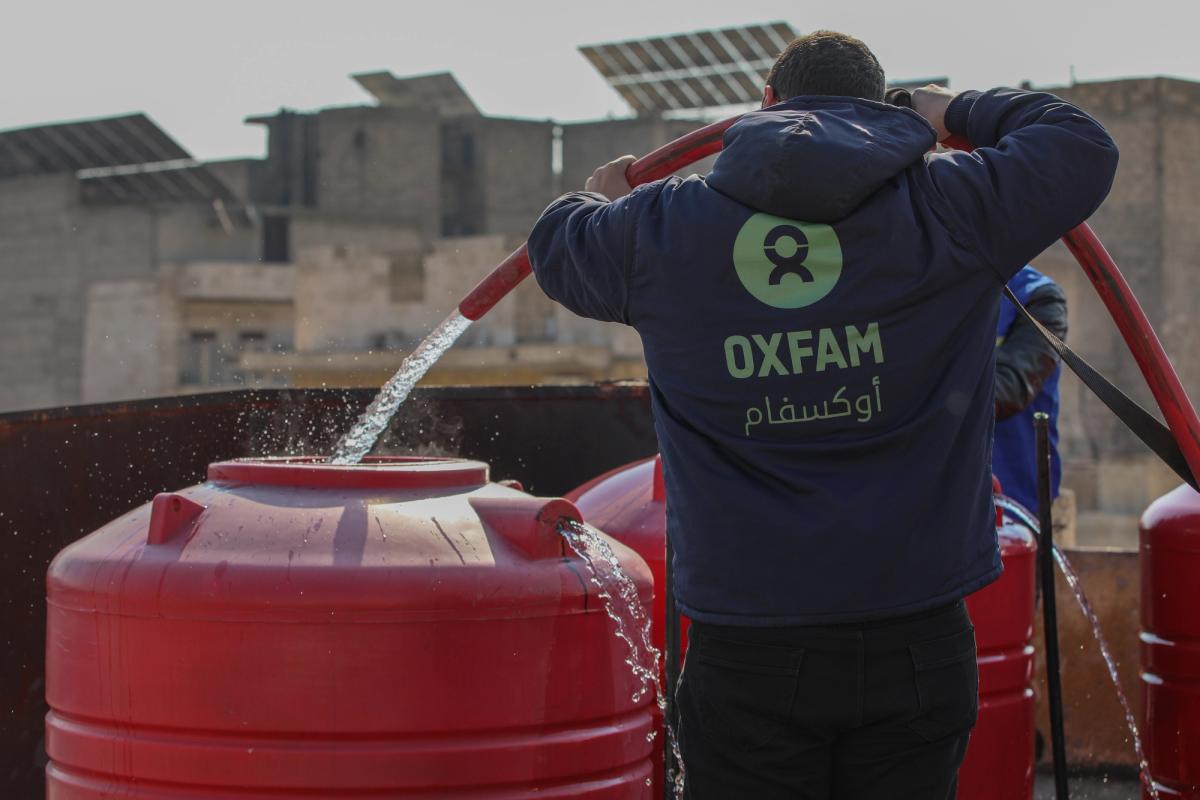
Water is one of the first things to go during conflict. Before the food runs out or hospitals stop functioning, people lose access to clean water.
Millions of people across the Middle East are living that reality right now. The Middle East water crisis is driven by an escalating climate emergency, ageing infrastructure, and long-term conflicts that have destroyed clean water systems.
The conflict in Iran has added a new and dangerous layer to a region already pushed to its limits, damaging desalination plants and disrupting supply chains.
In Gaza, Yemen, Syria and Lebanon, pre-existing water crises have become more deadly and harder to solve. Let’s take a look at what’s happening, and, importantly, how we can change that together.
A region already on the edge
Fifteen of the world's 20 most water-scarce countries are located in the Middle East and North Africa. It’s the most water-stressed region on Earth.
According to the World Resources Institute's Aqueduct data, roughly 83% of the region's population is already exposed to extremely high water stress (projected to reach 100% by 2050).
While the region has an arid climate, this is not simply a product of geography. Climate change is actively shrinking the little water that remains.
Rising temperatures are accelerating evaporation. Rainfall is becoming less predictable. Rivers that entire populations depend on (including the Euphrates and the Jordan) are carrying significantly less water than they did a generation ago. On top of this, decades of unsustainable irrigation, groundwater over-extraction and ageing, leaking infrastructure compounded the problem further.
Water scarcity in the Middle East was already a structural crisis before any recent conflict broke out because of long-term conflict in the region. And we know that conflict can turn a crisis into a catastrophe.
To understand more about how climate change is driving this, read Oxfam Australia's climate change explainer.
How conflict turns scarcity into catastrophe
In a water-stressed region where every drop of available water is already spoken for, there’s no buffer. Conflict doesn't need to be long or widespread to be catastrophic. Hit the wrong pipe, pumping station, or fuel supply, and whole communities are left without water.
Once that infrastructure goes down, it doesn't come back quickly. Blockades and active conflict prevent the arrival of engineers, spare parts and repair materials. Displaced people overwhelm systems that were already under-resourced. Even when water infrastructure itself isn’t damaged, fuel shortages can stop the water pumps. Or humanitarian aid funding dries up.
Communities that were coping through the water crisis, even slowly recovering, suddenly find themselves without water or the resources to fix the problem.
That’s exactly what’s happening in the Middle East now. Within weeks of the conflict in Iran beginning in February 2026, reports emerged of damage to desalination plants, infrastructure that millions of people in an already parched region depend on for drinking water.
The communities caught inside that cycle are not the ones who created it. The people with the least political power and the fewest economic resources to absorb the shock are paying the highest price. Across Gaza, Yemen, Syria and Lebanon, that pattern plays out with devastating consistency.
Middle East water crisis: Countries in the spotlight
Palestine: when water becomes a weapon
The Gaza water crisis is one of the most severe and deliberate water emergencies in the world. Most of Gaza's water networks and desalination plants are no longer functioning, having been destroyed by bombardment, disabled by fuel shortages, or left unrepaired because essential materials have been blocked from entering.
The human consequences are clear in the disease data. Oxfam Australia's own reporting documents a 150% increase in acute watery diarrhoea cases, a 302% increase in bloody diarrhoea, and a 101% increase in acute jaundice. These are all preventable, readily treatable waterborne diseases that are spreading because clean water can’t reach the people who need it.
By early 2026, the United Nations estimated that drinking water availability in Gaza City had fallen below six litres per person per day, well below even emergency humanitarian standards.
Oxfam has reached over 800,000 people with water, sanitation and hygiene support in Gaza since October 2023, working alongside Palestinian partner organisations to install small-scale desalination units, place water tanks and tap-stands, and repair infrastructure. The work continues under extraordinary constraints.
Support Oxfam Australia's Gaza response.
Yemen water crisis: a decade of war draining a country dry
Yemen was already one of the world's most water-scarce countries before conflict began. Years of unsustainable irrigation had pushed limited groundwater reserves to critical levels. Conflict then compounded every vulnerability, damaging infrastructure, stopping pumping stations, and making private water trucking unaffordable for many.
The health consequences have been catastrophic. By late 2025, cholera had affected 98% of the country. By early 2026, more than half the population was facing acute food insecurity — a crisis inseparable from the water crisis, because without safe water, food assistance alone cannot prevent malnutrition. An estimated 19.7 million people need humanitarian assistance, including 10.8 million children.
Oxfam has worked in Yemen since 2015, reaching more than three million people with clean water, sanitation and hygiene support. Learn more about how we deliver humanitarian aid.
Syria: when drought and war destroy the same rivers
When civil war broke out in 2011, 98% of people in Syrian cities had access to safe water. Today, only half of Syria's water infrastructure is functioning. The Syrian water crisis is the product of more than a decade of conflict layered on top of an accelerating climate emergency. Syrian communities are grappling with reduced flows in the Euphrates River, worsening drought, and the systematic destruction of water systems that communities depended on.
In 2025, Syria experienced one of its worst droughts in decades. Combined with years of conflict damage, it devastated agricultural production and pushed rural communities further into poverty. Today, 16.5 million Syrians require urgent humanitarian assistance.
Syria also remains one of the world's largest displacement crises, with 3.6 million Syrians still displaced in neighbouring countries (even as more than one million have returned home to conditions of ongoing insecurity and severely limited services). You can read more about forced displacement in our World Refugee Day article.
Lebanon: drought, displacement and a system at breaking point
Lebanon's water crisis arrived from two directions at once. The country was already experiencing its worst drought in decades, with reservoir levels at critical lows and a national water system almost entirely dependent on diesel-powered pumps.
A 2025 study by the Red Cross found that 91% of households were experiencing moderate-to-high water insecurity, which is insufficient to meet daily needs.
Then, on 2 March 2026, regional conflict escalation displaced more than one million people in a matter of weeks, overwhelming infrastructure that was already failing.
The acceleration of the Lebanon water crisis in 2026 has been stark. In the first four days of the March escalation alone, at least seven critical water sources were damaged, cutting off water to almost 7,000 people just in the Bekaa area.
Families who have lost their livelihoods and been displaced from their homes are increasingly dependent on private water trucking, which is unregulated, unreliable and, for most, unaffordable. In overcrowded shelters and informal settlements, deteriorating hygiene conditions are sharply raising the risk of cholera, dysentery and other waterborne diseases.
Across four countries, the pattern is the same: pre-existing fragility, conflict as an accelerant, and communities left without the resources or the power to fix what has been broken.
Will you stand with these communities? Donate to Oxfam Australia's International Crisis Fund.
What needs to change
The solutions to the Middle East water crisis are not a mystery.
These communities need wastewater treatment systems, upgraded water infrastructure so it’s more resilient, and reform groundwater management. Solar-powered desalination can extend clean water access even in areas where conventional supply has collapsed.
But technical solutions are difficult to deploy in active conflict zones. And they’re hard to sustain in countries where political instability, economic collapse and inequality leave communities without the resources or the power to maintain them.
So, what’s the answer?
The water shortage in the Middle East is not primarily a technical problem. We know how to start fixing it. Global governments need to:
- act on climate justice
- fund humanitarian response at the scale the need demands
- stop treating water infrastructure as an acceptable casualty of war
- establish a ongoing and sustained ceasefire
Oxfam Australia is calling on the Australian Government to increase investment in Australian aid, support a more just global economy and contribute to a safer climate future. We’re also calling on the Prime Minister to speak out against the conflict in the Middle East and stand for what so many Australians know is right.
Because the people bearing the heaviest cost of this crisis are the people who did the least to cause it. They’re displaced families rationing contaminated water, children hospitalised with preventable disease, and farmers watching their land slowly become unworkable.
Let’s call this what it is: inequality. Together, we have the power to change the systems that maintain that inequality.
How you can help
Donate to fund life-saving water and sanitation work
Support Oxfam Australia’s Middle East Crisis appeal to help provide clean water, hygiene kits, and support long-term restoration of clean drinking water in areas impacted by conflict across the Middle East.
Add collective pressure
Sign petitions and contact decision-makers to push the Australian Government to increase aid investment, act on climate justice and hold those responsible for infrastructure destruction to account. Visit Oxfam Australia's advocacy and campaigns page to add your voice.
Take action
Water is the most basic condition for human life. Right now, the people with the least power to change the systems are the ones paying the highest price — being left without enough water to drink, bathe and wash things.
That is poverty driven by inequality. And it is exactly what we exist to challenge.
A different future is possible, but it requires us all to act. Take action with Oxfam Australia.