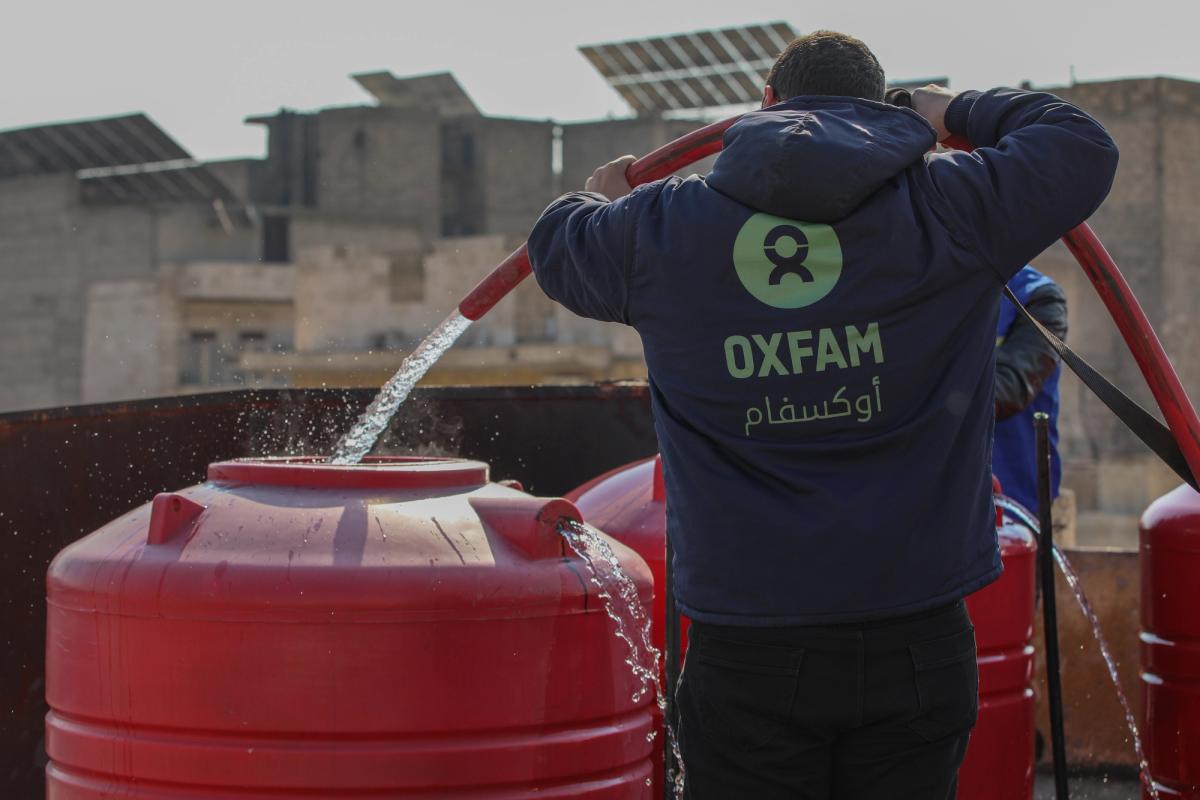
When civil war broke out in Syria in 2011, 98% of people in Syrian cities had access to clean water. Today only half of Syria’s water infrastructure is functioning.
That collapse is the story of the Syria water crisis: not a single disaster, but fifteen years of overlapping crises, each one making the others harder to survive.
Today, 16.5 million Syrians require urgent humanitarian assistance. This is part of a wider pattern of water stress across the region. Read our overview of the Middle East water crisis for broader context.
What’s driving Syria’s water crisis?
Syria’s water shortage isn’t the result of any single factor. It’s what happens when climate change, conflict, geopolitical pressure and decades of resource mismanagement all act on the same fragile system; each one compounding the others.
Climate change and drought
Syria’s 2024–25 rainy season was one of the most severely dry seasons in recent years, with rainfall approximately 60% below the annual average. Three major drought episodes between 2006 and 2021 had already depleted approximately 60% of groundwater reserves in northeastern Syria. Desertification has expanded to cover nearly 73% of the country in varying degrees.
The 2025 drought damaged wheat crops, according to the FAO, creating a wheat deficit of approximately 2.7 million tonnes and potentially leaving more than 16 million people struggling to access food for an entire year.
Rainfall indicators improved slightly in April 2026, but as the World Bank noted in May 2026, agriculture is still recovering from the sharp 2025 drought. The drought has not ended. It has eased slightly.
The collapse of Syria’s dam system tells the story in numbers. Syria has 164 major dams with a designed storage capacity of approximately 2.9 billion cubic metres. Their current storage levels are catastrophic: Damascus sits at 1% capacity, Hama at 10%, Idlib at 2%, Daraa and Raqqa at zero. The Orontes River, historically a significant water source, has experienced what Carnegie Endowment researchers describe as “unprecedented desiccation.” Water scarcity in Syria is no longer a seasonal problem, but a structural one.
Damaged infrastructure
More than a decade of civil war systematically destroyed Syria’s water systems: pumping stations, treatment plants, pipelines and distribution networks. The February 2023 earthquake added another difficult layer. It damaged water infrastructure across Aleppo and northwestern Syria that had survived the conflict, and displaced large numbers of people (which puts more strain on the water systems in the areas they travel to). Today only half of Syria’s water infrastructure remains functional.
Geopolitical pressures
Syria’s access to the Euphrates River, historically one of its primary freshwater sources, has been dramatically reduced by upstream dam construction in Turkey over several decades.
Syria’s share of Euphrates flows has fallen significantly as a result, leaving communities in eastern Syria increasingly dependent on groundwater reserves that are themselves being depleted by drought.
During the long civil war under the Assad regime, water infrastructure was also used as a tool of conflict by both sides, with supply deliberately cut to civilian populations as a pressure tactic. The fall of Assad in December 2024 changed the political context significantly.
State-directed targeting of water infrastructure (a documented feature of the Assad regime’s conduct) ended with the regime itself. And for the first time in over a decade, some sanctions have been lifted and the door to international reconstruction partnerships has opened. But water infrastructure remains at risk from ongoing conflict between armed groups in parts of Syria, and the path to recovery is uncertain.
What has changed is the possibility of sustained international engagement; something that didn’t exist before December 2024.
Resource mismanagement
Decades of unsustainable irrigation (a legacy of Soviet-influenced agricultural policy) were depleting Syria’s groundwater long before the conflict began. Syria was already drawing down its water reserves faster than they could recharge.
The conflict then compounded this inherited deficit. Conflict destroyed the infrastructure that might have enabled more sustainable management, while it also displaced the agricultural communities who depended on it.
None of these drivers operates independently. As Carnegie Endowment’s May 2026 analysis explains, Syria’s water crisis has become a self-reinforcing system: water scarcity accelerates soil degradation; degraded soil reduces agricultural output; and declining agriculture increases pressure on the water that remains as farmers draw more heavily on deep ground water, deepening the crisis with each cycle. This is not a problem that resolves itself. It requires deliberate, sustained intervention.
The human and economic cost of Syria’s water shortage
When water systems fail, the consequences cascade rapidly. From illness to poverty, from poverty to displacement, and from displacement back to more pressure on already failing systems.
There’s a direct link between contaminated water and disease in Syria. A cholera outbreak declared in September 2022 was linked by the United Nations to contaminated water from the Euphrates River.
By early 2023, more than 88,000 suspected cases had been recorded across the four most affected governorates: Idleb, Aleppo, Deir ez-Zor and Ar-Raqqa. Cholera resurged again in late 2024, prompting WHO to launch an emergency health and WASH response in May 2025 to protect more than 850,000 people at highest risk.
WHO’s emergency response targeted the immediate resurgence, but the underlying conditions driving cholera in Syria remain (contaminated water sources, damaged sanitation infrastructure and population displacement).
The economic toll runs deeper still. Agricultural collapse driven by drought and damaged irrigation systems has pushed rural communities across Syria into poverty. Farmers who once grew food and earned livelihoods from Syria’s fertile land now face destroyed equipment, contaminated soil and the impossible cost of seeds and inputs. All in an economy still rebuilding from years of sanctions and conflict. The World Bank’s 2025 assessment puts Syria’s reconstruction costs at $216 billion USD, which is nearly ten times the country’s entire 2024 GDP.
For families in cities and camps, water shortages mean relying on expensive trucked water or drawing from unregulated sources of unknown quality. Both options carry costs and risks that communities without resources can’t afford to absorb. Water shortages in Syria are a health and economic crisis in one; pushing families already living with poverty further from any path out of it.
Khadija’s story: Aleppo, 2023
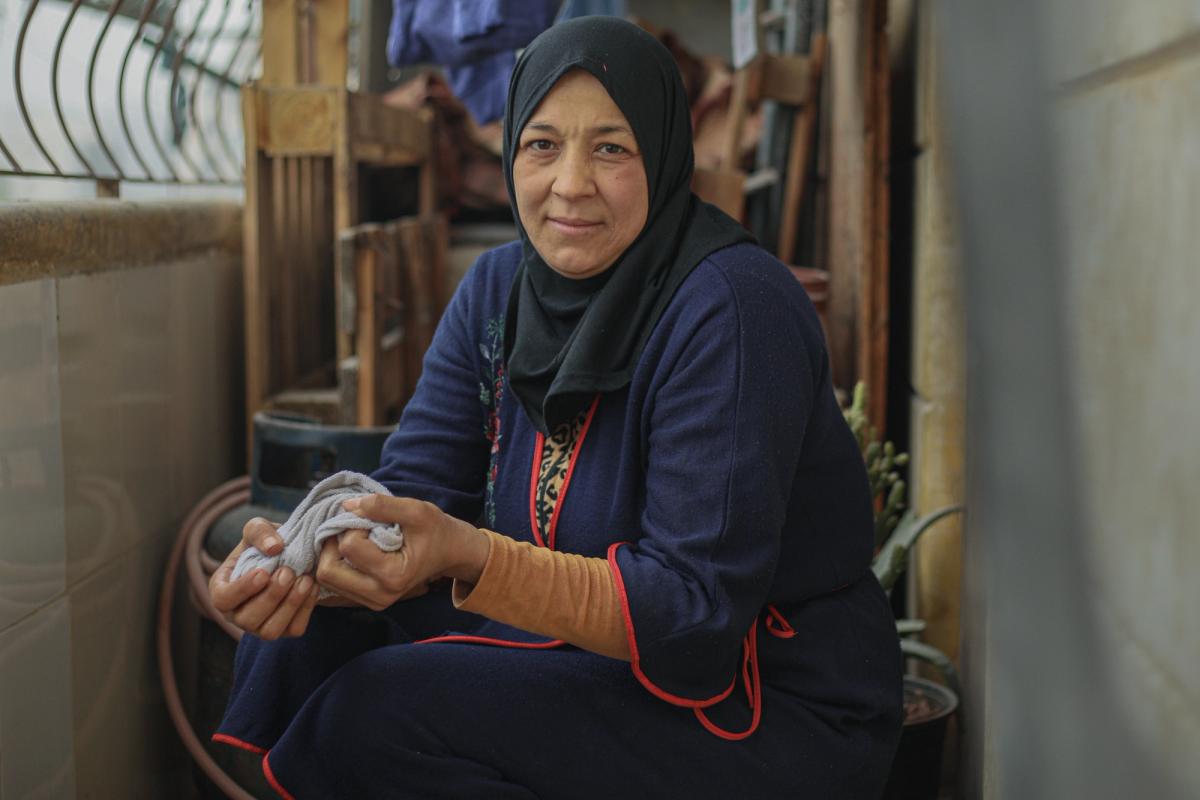
Aleppo, Syria: Khadija uses the hygiene supplies she received from Oxfam to help her maintain hygiene. Photo: Islam Mardini/Oxfam
In the weeks after the February 2023 earthquake struck northern Syria, Khadija was still going to work.
A mother of five in the Al Fardous neighbourhood of Aleppo, Khadija worked as a cleaner to support her family despite chronic back pain. Her husband worked irregularly as a daily labourer. The earthquake damaged their home, cut their power and made the already difficult water situation even worse.
‘Power was scarce before the earthquake and became even worse afterwards,’ she says. ‘We sometimes boil the unsafe water we buy from small trucks for drinking and cooking, but we cannot often afford to buy the means to fire the oven and boil enough water for our daily use. This is why we have to ration the water as much as possible.’
Her daughter has nightmares after the shock of the earthquake. ‘My daughter fears now the darkness and the high noises. She cries a lot and has bad dreams every night,’ Khadija says.
After the earthquake, Oxfam distributed hygiene and dignity kits to families in Aleppo. The kits include things like soap, washing powder, shampoo, menstrual pads, headscarves and solar lamps.
‘We were almost in the dark every night,’ Khadija says, ‘but the solar lamp we received gave us some light. It was my favourite item among all that I got.’
Help more people like Khadija and her family survive these overlapping crises with dignity and strength. Donate to our Middle East crisis appeal today.
How Oxfam is responding to Syria’s water crisis
Oxfam has been working in Syria since 2013, maintaining a humanitarian presence across eight of Syria’s 14 governorates through the civil war, the COVID-19 pandemic, the 2023 earthquake and the 2025 wildfires.
In 2024 and 2025, the Oxfam confederation and partners reached 2.4 million people in Syria with humanitarian assistance. Oxfam has rehabilitated wells and water and sanitation systems now serving more than 490,000 people across the country.
After the 2023 earthquake damaged the municipal water network in Aleppo’s Al-Ashrafieh neighbourhood (the same city where Khadija lives), Oxfam helped repair the main water supply network. Families who had been boiling trucked water or going without were reconnected to clean running water.
That’s the transition from emergency relief to community-led, long-term recovery: a pipe fixed, a pump restored, a neighbourhood reconnected to clean water.
In July 2025, conflict displaced nearly 200,000 people in Sweida Governorate in southern Syria. Alongside local partners like the Syrian Society for Social Development, Oxfam distributed 2,500 hygiene kits (with 4,000 more planned) and supplied 5,000 litres of fuel to keep water and food deliveries moving to families cut off by the displacement.
Longer-term, Oxfam and Syrian partners are running Farmer Field Schools, training growers to adapt to drought, manage water more sustainably, and rebuild agricultural livelihoods that the conflict and climate crisis have dismantled. This work reduces the pressure communities face when the drought intensifies again.
What needs to happen now
Syria’s water crisis developed from four overlapping failures. Long-lasting solutions need to address all four. For the first time in over a decade, the end of the civil war has made some of this possible.
Act on the climate crisis
The impact of the climate crisis in Syria can be reduced. Drought-resistant agriculture, more efficient irrigation and early warning systems can reduce how much damage each drought episode does to Syria’s food systems and water reserves.
Oxfam and partners are already beginning this work through Farmer Field Schools, training Syrian growers to adapt their practices to drought conditions and manage water more sustainably.
Alongside investment in drought-resistant seeds and more efficient irrigation, scaling this up is one of the clearest ways to reduce the damage future droughts inflict on Syria’s food security.
But addressing the climate crisis in Syria also means addressing it at the source. Syria’s per-capita emissions are a fraction of a country like Australia’s, yet Syrian farmers are watching reservoirs run dry and harvests fail because of a climate crisis they did almost nothing to cause.
As Australia prepares to preside over COP31 climate negotiations, Oxfam Australia is calling on the Australian Government to increase climate finance to lower-income countries and hold big polluters accountable for the damage their emissions cause. Sign Oxfam Australia’s climate justice petition, or learn more about Oxfam Australia’s climate justice work.
Rebuild water systems
Syria’s water infrastructure must be rebuilt at scale. With the civil war over, those working conditions have changed.
Engineers can access areas that were previously unreachable. Reconstruction materials and spare parts can enter the country.
Solar-powered water systems are critical here: they reduce dependence on fuel and diesel that conflict disrupts, and they can function even when national electricity grids fail. Oxfam’s experience with solar water pumping in Lebanon shows what forward-thinking infrastructure investment looks like.
Work with Syrian authorities
The geopolitical constraints have shifted since the fall of Assad in December 2024. That opened the door to international partnerships and donor funding that were previously constrained by diplomatic relationships with his government.
This is the cautious hope Syria’s water crisis has not had in over a decade. Not that the crisis is over, but that the international community can now engage with Syria’s reconstruction in ways that were impossible before. What happens next depends on whether that engagement is sustained.
Develop sustainable resource management systems
Resource management must change. Sustainable groundwater governance and reform of irrigation systems are long-term projects and they have to begin now. Syria’s groundwater reserves have been depleted by decades of over-extraction. Without reform, every drought will be worse than the last.
Donate to support Syria’s recovery (and the communities still in crisis)
Syria’s water crisis is the product of conflict, climate, mismanagement and geopolitics stacking on top of each other across decades. It won’t be resolved quickly. But the end of the civil war has opened a door that was closed for fourteen years, and what the international community does with that opening will shape Syria’s recovery for a generation.
From rehabilitating wells and repairing water networks to supporting agriculture adaptation and responding to displacement, Oxfam’s work addresses both the immediate need and the structural conditions driving it. Your support makes that work possible. Will you donate what you can today?
You can also read more about the water crisis in Yemen and Lebanon, or learn more about the broader Middle East water crisis.
If you’d like to know how else you can support our work, you can explore our current appeals or learn more about our International Crisis Fund.