Salary Sacrifice Charity Donations: Give through your pay
What is salary sacrifice?
In Australia, salary sacrifice is an arrangement where an employee agrees to receive a smaller salary (and only pay income tax on that smaller salary) in exchange for non-cash benefits. For example, the employee may choose to donate $15,000 via salary sacrifice in exchange for a work car.
Is it different to workplace giving?
It’s different to another term you may have heard: workplace giving. Workplace giving is a simple payroll deduction that sends a portion of your pay directly to a charity with Deductible Gift Recipient (DGR) status.
Why does it matter?
For donors, the distinction matters. Salary sacrifice benefits usually relate to employee entitlements or non-cash benefits (like the work car above), while workplace giving is treated as a charitable gift with accompanying tax benefits.
In short, salary sacrifice and workplace giving serve different purposes: salary sacrifice changes how part of your remuneration is provided, while workplace giving is the mechanism that allows donations to DGR charities to be made through payroll.
Last year, workplace givers donated $420,000 to Oxfam Australia, which continues to help us tackle poverty all over the world.
Workplace giving vs salary sacrifice: how it works
Not all workplaces offer workplace giving programs. But for those who do, it runs through your employer’s payroll system. Once you nominate a donation amount and choose a DGR charity, your employer deducts that amount from each pay cycle and transfers the total directly to the charity.
You’ll see the donation listed on your payslip, and usually your tax-time income statement. The donation is tax-deductible.
Salary sacrifice donations to charity are processed differently. They provide you with a benefit (such as extra superannuation or a work vehicle), so they aren’t considered charitable gifts and aren’t tax deductible for you (the employee). But it does reduce your taxable income, so you will pay less income tax for that year.
Understanding the difference helps you decide which option aligns with how you want to give, and how it affects you at tax time.
How workplace giving affects your tax
Workplace giving looks simple on your payslip, but there’s a bit happening behind the scenes. When you donate through your pay, your employer also adjusts the amount of tax they withhold from your pay.
So, your donation is processed through payroll and you receive the tax benefit straight away. You don’t need to track receipts — your payslips also serve as a record if you need one.
The end result is the same as claiming a deduction, but you receive the tax benefit as you go. It’s a streamlined way to give. Calculate your potential savings with our tax deduction calculator.
How salary sacrifice charity donations affect tax time
Salary sacrifice works very differently from workplace giving. When you salary sacrifice an amount, that money is never counted as part of your assessable income, and the ATO treats your employer as the donor (remember, you’ve received something in place of the cash).
But as the employee, your taxable income is lower straight away. You only pay tax on your reduced salary, so the benefit of salary sacrificing appears in your pay throughout the year.
Your employer then claims any relevant deduction. Donations made to DGRs generally don’t trigger a Fringe Benefits Tax (FBT) liability for the employer.
If you still have some questions about your donations and tax, read about the tax benefits of donating.
How to set up workplace giving
If your workplace offers workplace giving, getting started is simple. Choose how much you’d like to give, complete a short authorisation form, and your employer takes care of the rest. Here’s what the process usually looks like.
1. Check whether your employer offers workplace giving
Many organisations already have a program in place. If not, some employers are open to setting one up when employees ask.
2. Choose a charity with Deductible Gift Recipient (DGR) status
Only donations to DGR charities are tax-deductible, so it’s worth checking. You can use the ACNC’s Search for a charity to confirm a charity’s status. Oxfam Australia is a registered DGR.
3. Complete your workplace giving or payroll authorisation form
This form tells your employer how much you want to give from each pay. Once approved, the donation starts automatically.
4. Check your payslips
Your donation will appear as a separate line on your payslip. This helps you keep track of what’s being deducted.
5. Review your income statement at tax time
Workplace giving amounts will most likely show up automatically in your income statement, but that depends on your employer’s system. You can still use your payslips or income statement as your record if the amount isn’t prefilled in your tax return.
You can change the amount or stop the deduction at any time by submitting a new form to your employer. The process is flexible, and your employer’s payroll team can help if you’re unsure about any step.
How employers support workplace giving and salary sacrifice donations to charity
Employers play a key role in both workplace giving and salary sacrifice agreements.
Setting up workplace giving programs
For workplace giving, employers configure their payroll system to deduct your donation and send it to charity. These deductions are reported through Single Touch Payroll (STP) Phase 2 using the code “W – Workplace giving” which makes things smoother come tax time. No need to worry about tax receipts.
Facilitating salary sacrifice arrangements
Salary sacrifice works differently. The ATO requires employers to approve the arrangement before the employee earns the income and to provide the agreed benefit in place of some of your salary.
Payroll processes
Once approved, employers process deductions (or benefits) through payroll each pay cycle. For workplace giving, funds are transferred directly to the DGR charity. For salary sacrifice, payroll adjusts the employee’s salary and applies the agreed-upon benefit.
Employer matching
Some organisations will choose to match your salary sacrifice charity donations. Matching is optional and doesn’t affect how the employee’s donation is treated for tax purposes; it simply means the employer contributes an additional amount.
In all cases, employer authorisation and accurate payroll processing ensure the arrangement is compliant, transparent and correctly reflected in employees’ income statements.
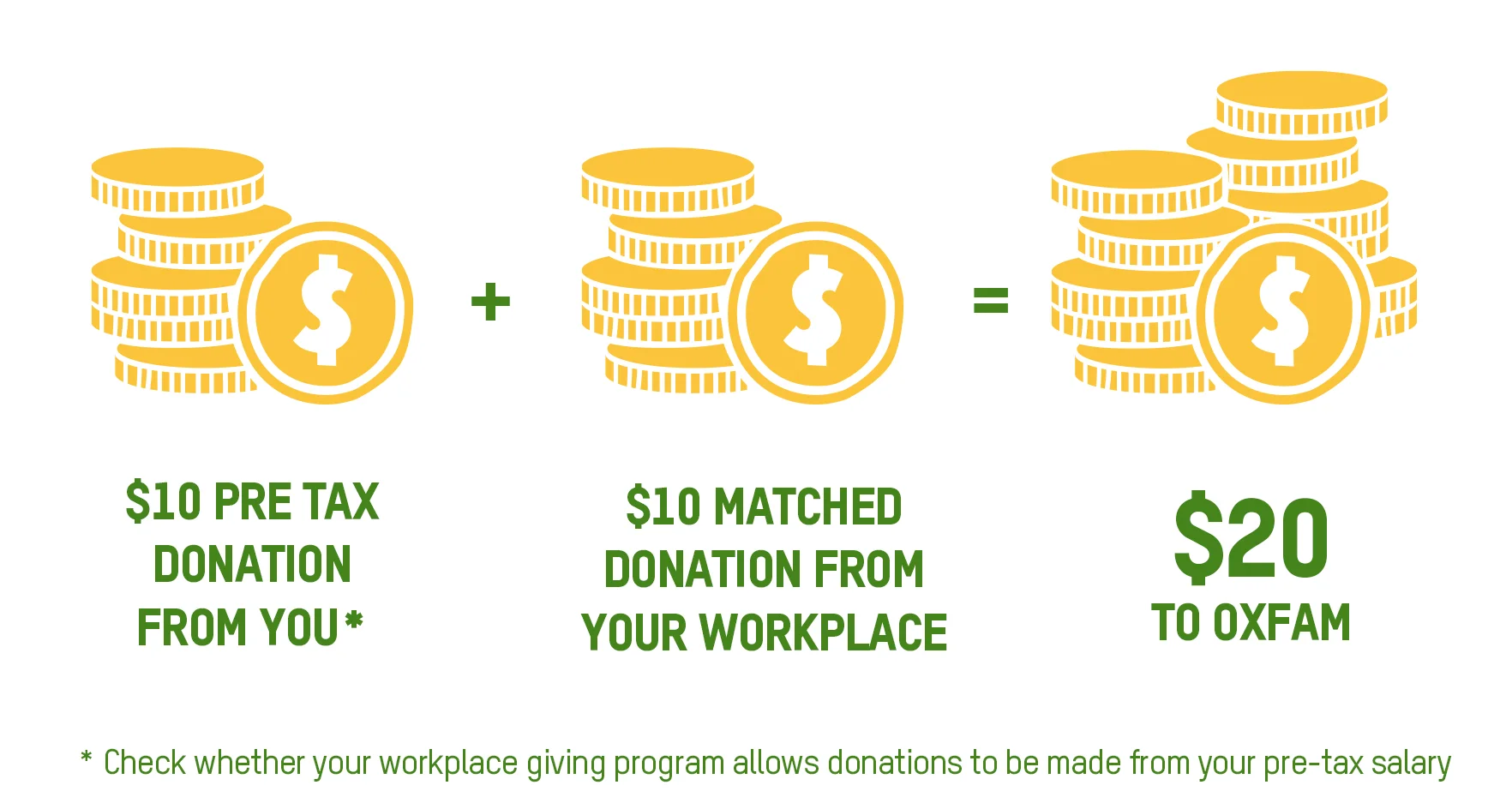
Why should you give through your pay?
- It’s easy — decide how much to give, and it’s automatically deducted with each pay cycle.
- If arranged with your employer, you could make your donations from your pre-tax salary (that is, a salary sacrifice arrangement). You would then pay tax on your reduced salary.
- Alternatively, you could arrange with your employer to give from your after-tax pay, and your employer may adjust the amount of tax deducted from your salary each pay cycle to account for the donation. You will still need to report a deduction at tax time.
- You could also ask your employer to match your donation.
- You’ll be part of a valuable community of regular donors. Regular donations allow Oxfam Australia to plan for the future so we can do even more with your donation.
- Your contribution can help people access clean water, send kids to school, empower women and save lives around the world.
Why choose Oxfam Australia
When you donate through your pay, you’re providing the kind of steady, predictable support that long-term change depends on. It means Oxfam and our partners can plan ahead, respond quickly and stay with communities for as long as we’re needed — not just during emergencies, but in the years that follow.
Donations of $2 or more are tax-deductible. But the real value lies in what regular giving makes possible. It strengthens community-led solutions: clean water systems, climate adaptation, support for people displaced by conflict, and programs that advance gender equality and economic justice. All of which help tackle the inequalities that keep people in poverty.
These are complex challenges, shaped by long-held systems, and they require sustained, reliable funding. You can explore some of the work your support strengthens: Gaza crisis appeal, South Sudan appeal, Rohingya appeal, or browse all current appeals.
Giving from your pay doesn’t just send resources during emergencies; it strengthens the capacity of local partners and communities who are already driving change. That’s why regular support (even in small amounts) has such a meaningful impact over time.
Disclaimer: the information on this page is general in nature and you should always speak to your tax advisor about your individual circumstances. You should also speak to your employer about the specific terms of your employer’s workplace giving policy.