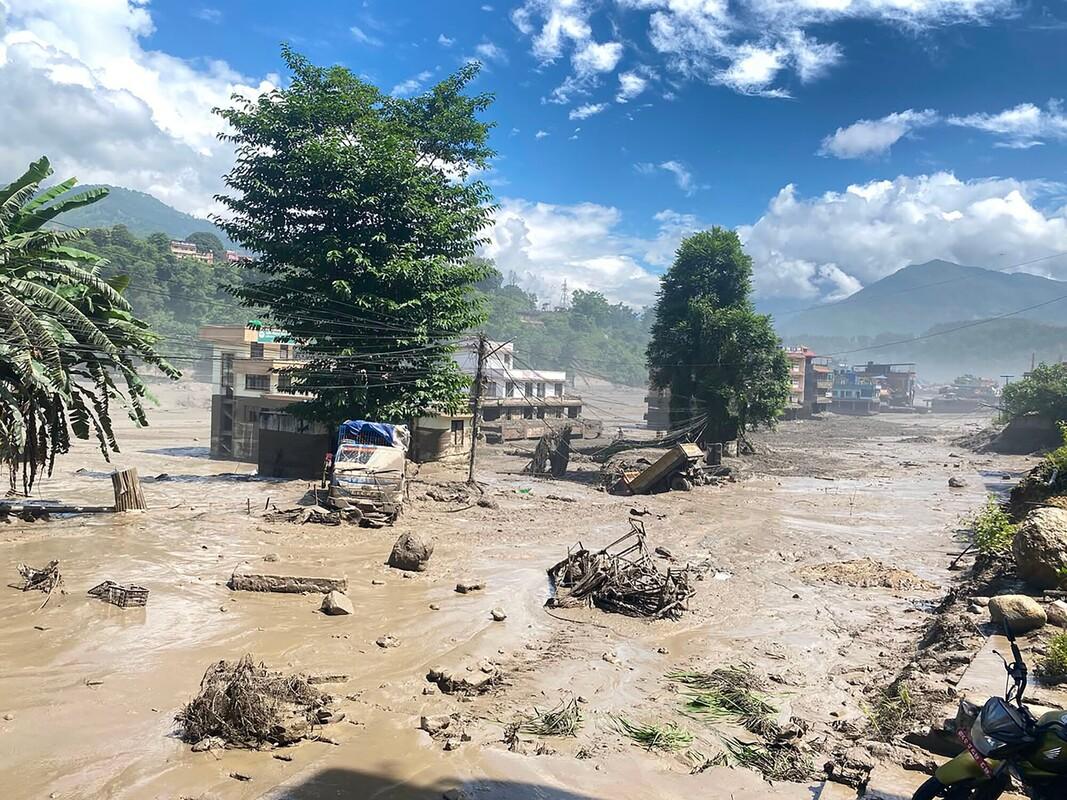
On 26 August, a glacier collapsed and triggered an unprecedented and devastating flash flood. A secondary flood wave struck Nepal on 30 August, compounding the damage. The scale of this disaster is unimaginable. You can read more about what happened in our Nepal flash flood explainer blog.
For many years, Oxfam has been supporting communities to prepare for and adapt to climate change impacts, but nothing can prepare for a disaster of this scale. In addition to providing urgent humanitarian support, we must look to what is required for the long-term recovery and act to address the drivers behind such extreme disasters.
The catastrophic floods in Nepal and Tibet are a stark warning of what a hotter world will mean for communities who live in areas at high risk of climate change impacts and why governments must invest now in keeping people safe from climate change impacts through better disaster preparedness and building back better in safer locations and with more resilient infrastructure.
The Nepalese government have estimated recovery costs from the catastrophic flash flood will be up to USD$5 billion, which is equivalent to about a tenth of Nepal’s economy. Without developed countries like Australia stepping up with adequate immediate humanitarian and longer-term recovery funding, Nepal may never recover properly and end up saddled with huge debt.
We know that the climate pollution from burning coal, oil an gas is the major cause of climate change, and Nepal is responsible for just 0.1% of global pollution. They have done very little to cause the crisis, yet are at extreme risk from the impacts and have few resources to recover.
This injustice is at the heart of why big fossil fuel producing countries like Australia must stop approving new coal, oil and gas mines, and step up our funding support for communities, including those in Nepal.
Here’s what we know about how the flash floods in Nepal and Tibet, and extreme weather around the world are linked to climate change, and what we must do to avoid humanitarian crises like this in the future.
What triggered the flash floods in Nepal and Tibet?
The major flash flood on 26 August was triggered by a massive glacier collapse and ice-rock avalanche that blocked the Lhende Khola, 20km north of the Rasuwagadhi checkpoint. The numbers of dead and missing continue to climb, with over 1200 people dead and 5500 people remaining unaccounted for.
Those that have survived are now in urgent need of life-saving supplies. After losing homes, family and livelihoods, tens of thousands of people are currently displaced and lacking adequate food, clean water and shelter.
Were the flash floods in Nepal and Tibet caused by climate change?
Nepal is highly exposed to floods, landslides and earthquakes. Climate change is adding further pressure through rapidly changing glaciers, snow and water systems and increasingly unpredictable extreme weather.
Experts have indicated that higher temperatures associated with climate change have been increasing snow and glacial melt. In the Himalayas mountain range that runs through Nepal, India, China, Bhutan and Pakistan, temperatures have risen double the global average of 1.4 degrees. As a result, the permafrost is thawing, causing glaciers to become unstable. In the case of the Nepal-Tibet disaster, a huge block of glacial ice collapsed, causing the avalanche of water, mud and debris. There might also have been seismic factors involved. Scientists predict that flooding disasters associated with glacial and permafrost melt will become more frequent and intense as climate change gets worse.
According to said Santosh Pandey, Oxfam in Nepal’s Humanitarian and Disaster Risk Management Lead, far more investment is needed in climate adaptation, early warning systems, disaster preparedness and resilient infrastructure, particularly in countries that have contributed little to global emissions.
“The lesson from Nepal is clear: resilience saves lives,” said Pandey. “If we only fund the response after a disaster, we will always be one step behind. Communities need sustained investment to prepare for the shocks we know are coming.”
“Nepal needs international solidarity now, but it also needs investment for the future,” said Pandey. “Climate action must become a priority, not an afterthought.”
Is climate change driving other extreme weather patterns around the world?
Over the northern hemisphere summer there were widespread heatwaves and wildfires in parts of Europe and North America. Excess deaths from the back-to-back heatwaves reached 35,000 in Europe. There have also been more severe storms and floods in parts of Asia, with over 1.1 million people across Bangladesh badly impacted.
A ‘godzilla’ super el Nino is also on the way. Global ocean temperatures have hit record-breaking levels. The current El Niño event is adding heat to the system on top of decades of human-driven warming. The El Nino is predicted to threaten global food security, bringing more intense heat and storms to the Pacific, and drought, extreme heat and bush fires to Australia.
In the same week the Nepal – Tibet disaster occurred, the United Nations released a report showing that the world has exceeded the 1.5°C warming limit agreed at UN climate talks. This limit was set based on expert scientific evidence that indicate it will reduce the risk of the most catastrophic impacts of climate change.
This report and the significant impacts we have seen in 2026 must be an urgent wake-up call for Australia and the world to take action to phase out coal, oil and gas and provide the funding to low-income communities to transition to renewable energy and be safe from climate impacts.
What can Australia do to prevent such great harm from climate change related disasters now and into the future?
When it comes to providing support to countries like Nepal, Australia isn’t lifting its weight. The Australian Government has committed just $11 million in support so far to this humanitarian crisis. Meanwhile, Nepal’s leaders are estimating it will cost up to USD$5 billion to recover, equivalent to 10% of their economy. Without further support, the long -term recovery will be inadequate, people will remain a high risk and Nepal will be saddled with greater debt.
We are the lucky country. We can do far more.
Over the 2020-2025 period Australia has provided less than $100 million in climate funding to South Asia, despite it being one of the most vulnerable regions in the world to climate change impacts.
Under the United Nations global climate agreements, Australia, like all developed countries, has agreed to provide climate finance to developing countries who are vulnerable to climate change impacts and who need support to transition to renewable energy. This is in recognition that developed countries are high historical climate polluters who have benefited from the use of coal, oil and gas, and who have financial means to support vulnerable countries.
But so far, Australia hasn’t been providing its fair share in climate finance and is providing less than peer countries like the UK, Germany or Netherlands. Australia must step up its funding to start to meet the scale of the need, so that countries and communities in least developed countries like Nepal are not left with billions in debt and devastation that they can’t recover from.
Australia’s previous climate finance pledge has expired. This year the Australian Government must announce its new climate finance goal in line with the global goal agreed at the UN Climate talks of USD$300 billion by 2035.
We are calling for the Australian Government to set a goal of $11 billion in climate finance from 2025-2030 to provide much needed support to low-income countries like Nepal and in the Pacific.
There is more than enough money in the world to meet the climate finance needs of developing countries. Australia provides around $14.5 billion in fossil fuel subsides per year, far greater than the $2.2 billion per year on average we are calling for to support our region.
The Australian government must also stop making climate change worse. It must stop all approvals of new coal and gas projects, end the subsidies to the industry, and start holding big polluting coal, oil and gas corporations to account. One in three coal, oil and gas corporations pay no corporate income tax in Australia and they pay little for their damages to the climate. Australia must make them pay their fair share through a levy on their climate pollution.
What’s Australia’s role at the COP31 United Nations Climate Summit this year?
Australia is President of Negotiations at the UNFCCC COP31 climate summit in November this year. This is a critical role, where Australia will be expected to shepherd, guide and inspire countries towards progress on key issues.
One key issue at COP31 is developed countries delivering on their commitments to provide climate finance to developing countries. These funds are critical for low-income countries to have the resources to electrify and transition to renewable energy. They are also critical for countries like Nepal or those in Pacific to prepare for and minimise the impacts of more devastating storms, sea level rise and loss of ocean life.
As President, Australia must shepherd and lead other developed countries to make new climate finance pledges, as well as make progress on the transition away from fossil fuels to help stop these impacts from escalating. We are also calling for the Australian Government to take the lead by setting its own new goal of $11 billion in climate finance from 2025-2030 to provide much needed support to low-income countries like Nepal and in the Pacific.
There is more than enough money in the world to meet climate finance needs and prevent future loss of life from disasters like this one. Its just a matter of political will to deliver them.
For example, just eight big oil and gas corporations made $93 billion in profits amid the recent oil crisis. Governments need to ensure these corporations, who are most responsible for the climate pollution driving climate change, pay their fair share for the damages. By making these corporations pay profits and pollution levies we can encourage these corporations to shift to renewable energy and we can raise the funds needed to support a just transition to safe climate and a more equal future.
Another way to raise the funds we need to tackle climate change is the end the subsidies to the fossil fuel industry. Australia provides around $14.5 billion in fossil fuel subsides per year, far greater than the $2.2 billion per year on average we are calling for to support our region.
Its time Australia truly commits to ensuring a safe climate and a more equal future. Please join us in calling for greater action.
Please sign Oxfam’s petition, calling on the Australian Government to set a strong new international climate finance goal, and to make big polluting corporations pay their fair share.